Buying Guide
Best Keurig Coffee Makers for Pods, Pots and Milk Drinks
Choose K-Elite for flexible single cups, K-Classic for simple controls, K-Duo Gen 2 for pods plus a pot, or K-Café SMART for coffee with hot or cold frothed milk.
Coffee Corner may earn a commission if you buy through this link, at no extra cost to you.
 AI
The shortlist
Choose for your daily routine
Start with the drinks you make each day. Then check room to open and refill the brewer, the height of your mug and whether you want to load loose grounds.
Flexible single-serve choice
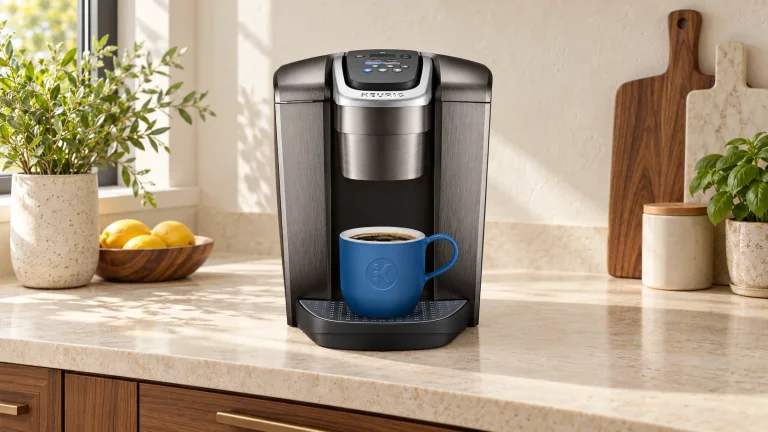
Keurig K-Elite
Choose the K-Elite for five cup sizes, Strong and iced settings, and a larger reservoir.
Read the details and trade-offsSimple pod routine
Keurig K-Classic
Choose the K-Classic if you need a straightforward 6, 8 or 10 oz coffee and do not need iced or Strong buttons.
Read the details and trade-offsPods and a shared pot
Keurig K-Duo Gen 2
Pick the K-Duo when a household needs single K-Cup drinks and a carafe made with ground coffee.
Read the details and trade-offsPod coffee with milk
Keurig K-Café SMART
Choose K-Café SMART for concentrated coffee shots, adjustable brew settings and an included hot/cold milk frother.
Read the details and trade-offsIf you are still deciding on a brewing system, compare the capsule choices in our Nespresso machine guide and the drip options in the coffee maker guide. The coffee gear buying guides let you compare those routines before committing to pods.
Side by side
The numbers and features that matter
Capacities refer to the named versions. Coffee-maker cup labels are not standard mug sizes; a reservoir’s full volume does not predict exactly when its refill light will appear.
Comparing 4 models. On small screens, swipe the table or use the arrow keys.
| Feature | Keurig K-EliteK-Elite · Brushed Slate | Keurig K-ClassicK-Classic · Black | Keurig K-Duo Gen 2K-Duo · second generation · Black | Keurig K-Café SMARTK-Café SMART · Black |
|---|---|---|---|---|
| Best reason to consider it | Choose the K-Elite for five cup sizes, Strong and iced settings, and a larger reservoir. | Choose the K-Classic if you need a straightforward 6, 8 or 10 oz coffee and do not need iced or Strong buttons. | Pick the K-Duo when a household needs single K-Cup drinks and a carafe made with ground coffee. | Choose K-Café SMART for concentrated coffee shots, adjustable brew settings and an included hot/cold milk frother. |
| Water reservoir | 75 fl oz | 48 fl oz | 72 fl oz shared | 60 fl oz |
| Coffee format | K-Cup; 4–12 fl oz options | K-Cup; 6, 8, 10 fl oz | K-Cup + ground-coffee carafe | 2/4 oz coffee shots + 6–12 oz cups |
| Milk workflow | Add a separate frother | Add a separate frother | None built in | Hot/cold frothing cup; hand wash |
| Main limitation | The water level is awkward to see from the front. | No 12 oz cup button or dedicated Strong mode. | Recent owners report early failures and water-system errors. | The frother needs hand washing; the Shot setting is not espresso. |
| Details | Specifications, pros and cons | Specifications, pros and cons | Specifications, pros and cons | Specifications, pros and cons |
Make it personal
Find what fits your kitchen
Choose the features you need, then check the practical trade-offs in each product report.
Your must-have features
Select requirements to narrow the list.
Read the product reports for maintenance, compatibility and practical limitations.
A closer look
What you get—and what to live with
Compare the equipment, preparation and maintenance before choosing a model. Check the model number as well as the name; similar listings can include different versions.
01 · Flexible single-serve choice
Keurig K-Elite
Choose the K-Elite for five cup sizes, Strong and iced settings, and a larger reservoir.
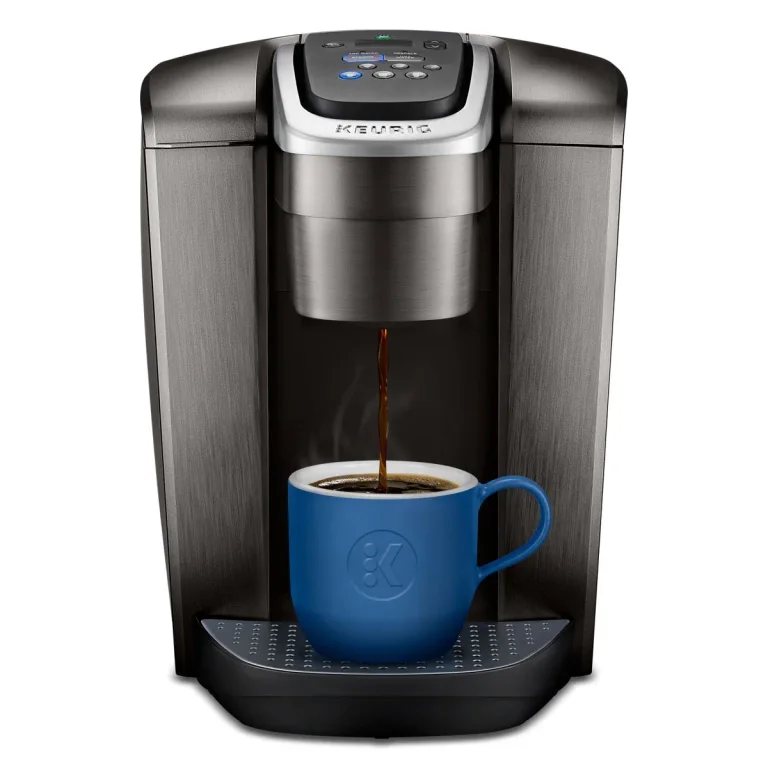
Exact model · K-Elite · Brushed Slate
Coffee Corner may earn a commission if you buy through this link, at no extra cost to you.
Pros
- More cup sizes than the K-Classic.
- Strong, iced and hot-water functions.
- Larger reservoir between refills.
Cons & limitations
- The water level is awkward to see from the front.
- Auto On heats the machine; it does not automatically brew a pod.
Five sizes and useful brew controls
The K-Elite suits a household that wants different mug sizes without changing systems. Its Strong option changes the brew, and the iced setting brews hot coffee over ice; neither turns a K-Cup into an espresso shot. Use a heat-safe, non-glass vessel for the iced routine as Keurig directs.
Leave room to lift and refill
The water level can be awkward to see from the front. Leave a view of the reservoir and room to lift it off for filling. Auto On warms the machine; it does not automatically brew a pod. Check the seller’s included-parts list if you want a water-filter holder: recent buyers report that it is not always in the box.
02 · Simple pod routine
Keurig K-Classic
Choose the K-Classic if you need a straightforward 6, 8 or 10 oz coffee and do not need iced or Strong buttons.
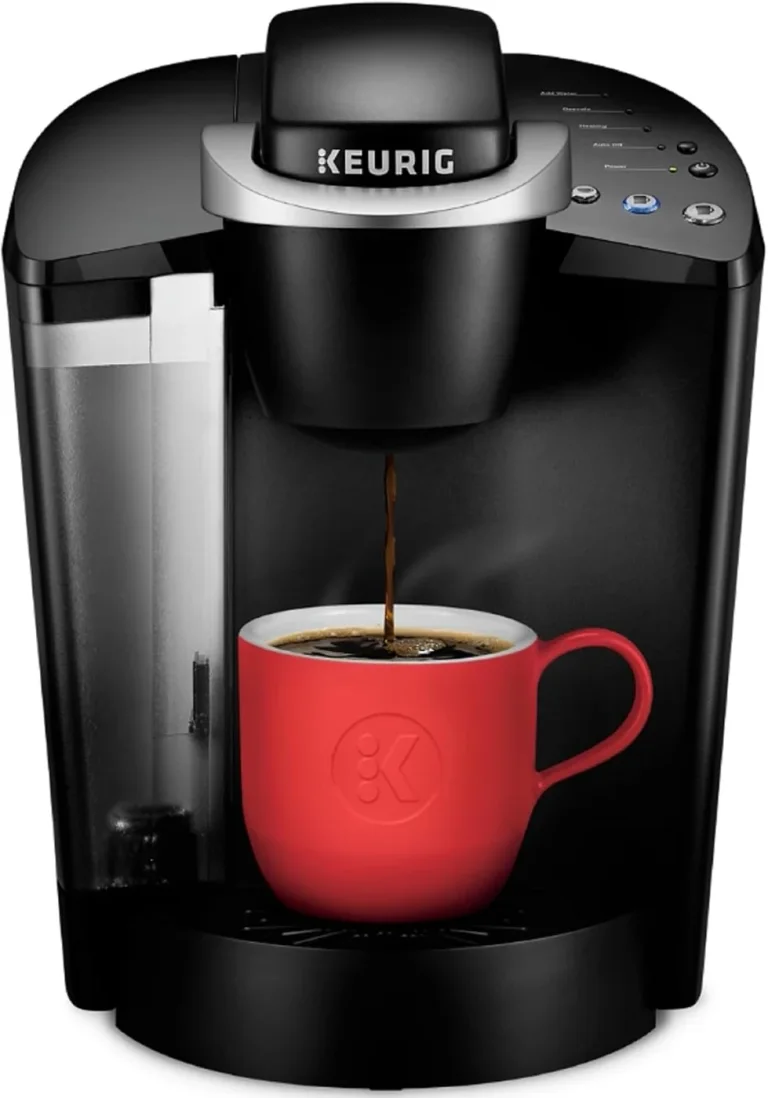
Exact model · K-Classic · Black
Coffee Corner may earn a commission if you buy through this link, at no extra cost to you.
Pros
- Straightforward cup-size controls.
- Removable 48 oz reservoir.
Cons & limitations
- No 12 oz cup button or dedicated Strong mode.
- Smaller reservoir than K-Elite.
Fewer choices can be enough
This is a sensible comparison when the K-Elite’s extra settings would sit unused. The smaller reservoir means more refills, but the basic pod workflow is similar: insert a pod, select a size, then dispose of it once the cycle is complete.
Compare older models carefully
The retired K575 and K200 are no longer our starting recommendations. A scarce older listing, a large historical review total or a touchscreen is not enough reason to prefer one over a currently offered model. Compare the actual seller, return terms and reusable-filter compatibility for any older machine.
03 · Pods and a shared pot
Keurig K-Duo Gen 2
Pick the K-Duo when a household needs single K-Cup drinks and a carafe made with ground coffee.
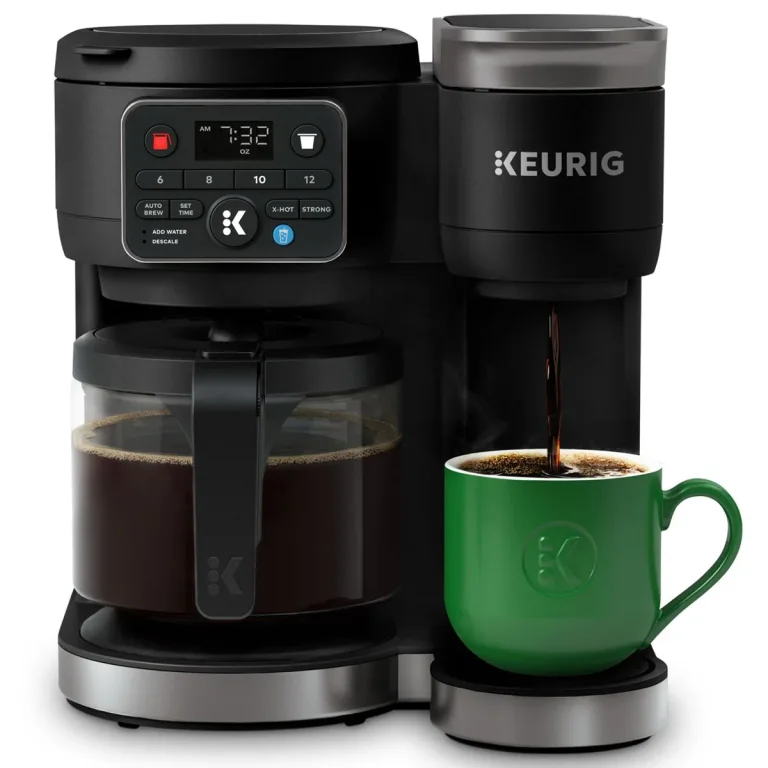
Exact model · K-Duo · second generation · Black
Coffee Corner may earn a commission if you buy through this link, at no extra cost to you.
Pros
- Two genuinely different serving routines.
- Scheduled carafe brewing.
Cons & limitations
- Recent owners report early failures and water-system errors.
- Both pod and carafe areas need cleaning; no milk frother.
Pods on weekdays, a pot when you need it
The single-serve side is useful when only one person wants coffee; the carafe side makes more sense when several people will drink together. A shared reservoir does not remove the need to load the correct coffee and vessel for each side.
Match the second-generation controls
This is the second-generation K-Duo, not the K-Duo Plus or an older K-Duo. Match the pictured controls and exact listing. Strong and X-Hot apply to single-serve brewing; the carafe uses a separate ground-coffee basket. Set the clock before programming a pot with Auto Brew.
Consider the ownership trade-off
Recent Amazon owners praise the programmable pot and single-cup flexibility, but others report early failures, water errors or a descale light that stays on. Those reports make the return window and seller support worth checking. Choose it because you need both brewing sides, rather than assuming more functions mean longer life.
04 · Pod coffee with milk
Keurig K-Café SMART
Choose K-Café SMART for concentrated coffee shots, adjustable brew settings and an included hot/cold milk frother.
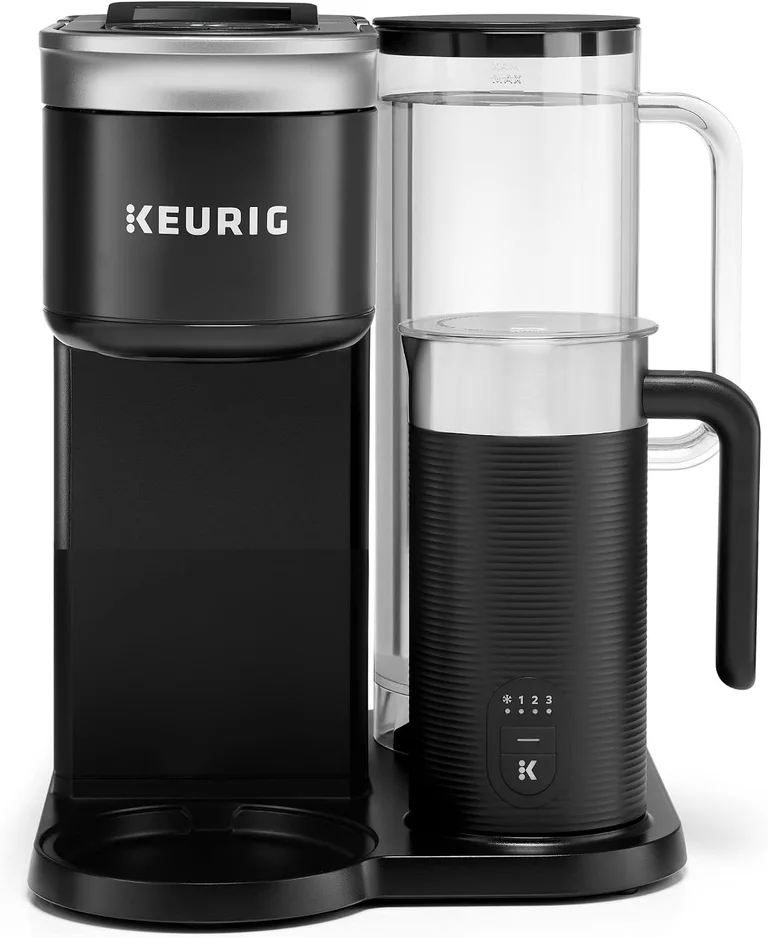
Exact model · K-Café SMART · Black
Coffee Corner may earn a commission if you buy through this link, at no extra cost to you.
Pros
- Includes hot and cold milk frothing with three hot-froth settings.
- Five strength settings and six temperature settings for regular coffee.
- 2 oz and 4 oz coffee shots for milk drinks.
Cons & limitations
- The frother needs hand washing; the Shot setting is not espresso.
- App features add setup; owner reports include connectivity and Add Water faults.
A new milk-drink option
The K-Café SMART pairs 2 oz or 4 oz concentrated coffee with frothed milk. It also makes regular 6–12 oz cups. Choose it for milk drinks within the K-Cup system; a pump espresso machine serves a different purpose. The linked Black version is the SMART model, with BrewID and app-connected recipes. You can adjust regular coffee through five strength and six temperature settings.
Froth first, then brew the shot
Fill the frother between its marked limits, choose cold froth or a hot-froth setting, and start it. Select a 2 oz or 4 oz shot and press Brew; the coffee queues until frothing finishes. Pour the milk over the coffee. The two functions do not run together. Hand wash the frother after use; do not immerse it or put it in a dishwasher.
Decide whether the connected features help
BrewID and app scheduling need a Wi-Fi connection; ordinary brewing can be set up without connecting. Recent SMART owners praise the frother and saved routines, while others report connection trouble or persistent Add Water errors. Choose it for the drinks and controls you will use, rather than assuming the app improves reliability. If you mainly drink black coffee, K-Elite is the simpler fit.
Check mug height and room to open the handle
A Keurig can fit beneath a cabinet with its handle closed and still need to be moved every time you load a pod. Measure from the countertop to the underside of the cabinet, then check the handle-open height. Keep room to lift the reservoir out and to pull the drip tray toward you.
| Model | Closed H × W × D | Height with handle open | Mug clearance |
|---|---|---|---|
| K-Elite | 13.1 × 9.9 × 12.7 | 16.5 | 6 with drip tray |
| K-Café SMART | 12.7 × 11 × 12.1 | Check open-handle and reservoir access before placing under a cabinet | Up to 7 with tray removed |
The SMART has a different footprint from the original K-Café. Use the SMART specifications for the closed machine and the SMART manual for its 7-inch travel-mug limit with the tray removed. Leave additional space to open the handle and lift out the tank; closed dimensions alone do not establish cabinet clearance.
For example, 15 inches beneath a cabinet clears the closed K-Elite but not its 16.5-inch open handle. Leave a stable, level place to load and refill the brewer without stretching its cord. Don't move it during a brew.
A tall 12-ounce travel cup may be harder to place than a wider cup holding the same volume. Check its height, then choose a brew size that leaves space for milk or ice. The coffee station layout guide helps plan the refill and cleanup area.
Match the reusable filter to its own instructions
Before buying a reusable filter, compare its lid and housing with the manufacturer's pictures. My K-Cup generations install differently, so keep the instructions supplied with yours.
Keurig's current gray, hinged-lid My K-Cup filter goes inside the brewer's pod holder. Open its lid, add ground coffee, close it and insert it as shown in the current product instructions. Don't carry over a holder-removal step from a different accessory. If it won't seat properly, stop and check the filter generation; forcing the handle is not a fit test.
The current product's compatibility graphic excludes Keurig 2.0, commercial brewers and K-Crema. Check both the machine name and the accessory version, even when the package says “universal.”
The SMART uses multiple entrance needles. Its manual warns against older reusable filters; confirm the accessory supports MultiStream brewers before closing the handle.
A reusable coffee filter holds grounds. A water-filter cartridge treats the reservoir water. They are separate accessories, and neither replaces the large basket used for a K-Duo carafe. Buy for the brewing side you intend to use.
Compare the coffee bill over the same period
Count brews, not people. Two people having one pod each use 60 pods in a 30-day month. Someone making two pods for a large milk drink uses twice as many pods per drink. Divide the delivered pack price by its pod count before comparing offers.
For ground coffee, divide the bag price by its weight in grams and multiply by the dry dose you actually use. Keep that dose within the reusable filter's instructions. The example below uses an assumed 10 g dose only to show the arithmetic; it is not a filling instruction or a claim that every filter holds 10 g.
| Input | Pods | Ground coffee |
|---|---|---|
| Purchase assumption | $18 for 24 pods | $12 for 340 g |
| Coffee for one brew | 1 pod | Assumed 10 g |
| Coffee cost per brew | $0.75 | About $0.35 |
| 60 brews over 30 days | $45.00 | About $21.18 of coffee used |
The ground-coffee column allocates the cost of 600 g used. Buying two complete 340 g bags would cost $24 and leave 80 g for later. Add the reusable filter, any paper liners, delivery and coffee wasted while adjusting the recipe. A lower ingredient cost doesn't account for the extra filling and washing.
If a whole pot is the household's normal breakfast drink, compare the K-Duo's carafe routine with a dedicated drip coffee maker. Repeatedly filling a single-cup filter may save money on pods while adding work you don't want.
Check the symptom before replacing the brewer
Use the instructions for your exact model. The steps below distinguish a setting or seating problem from a fault that needs service.
- K-Elite coffee is too mild, but the selected cup finishes normally.
- Try the same pod and cup-size setting with Strong selected for the next brew. Compare the resulting strength before changing the pod as well. This checks a brew-setting choice; it does not address a machine that stops partway through. K-Elite instructions.
- K-Elite stops short after the reservoir was lifted during brewing.
- Refit the reservoir and run the manual's rinsing brew without a pod. Watch whether a normal rinse resumes. If short cups continue, follow the manual's needle-care and descaling diagnosis; unplug before cleaning and keep fingers away from the sharp needles. Don't assume a larger cup button will solve it. K-Elite troubleshooting.
- The K-Café SMART will not froth while coffee is brewing.
- Wait until brewing finishes, then press the frother button. The two functions cannot operate together. If it still will not turn on while the brewer is idle, unplug the brewer for 30 seconds and retry; contact Keurig if it remains unresponsive. SMART frother troubleshooting.
- The SMART keeps showing Add Water after a refill.
- Check that the reservoir is seated properly in its base, then retry with sufficient water. Watch whether the warning clears and a normal brew starts. The manual directs you to customer service if the warning persists after refilling; repeatedly adding water or opening the machine is not a repair. SMART Add Water guidance.
- The K-Duo Gen 2 descale light stays on after an ordinary cleaning brew.
- Check whether you followed the dedicated Descale mode, including both brewing sides and the full fresh-water rinse. Begin again with the exact Gen 2 manual's descaling procedure, using the specified vessels and no coffee. Watch for the machine to exit Descale mode after the final carafe rinse. A reset shortcut copied from a different generation doesn't establish that the cleaning cycle finished.
- The current hinged My K-Cup won't sit correctly after replacing an older filter.
- Check whether the brewer's regular pod holder is fitted: the current gray filter is inserted into that holder. Follow its pictured installation, then check that it seats without forcing the handle. This is a compatibility check, not advice to modify the filter or needle. Current filter instructions.
Allow for everyday cleanup
Pods simplify dosing, but the used pod and drips still need attention. A reusable filter adds emptying and washing after each cup; a K-Duo adds a carafe and basket; a K-Café SMART adds a milk vessel. Choose the routine you are willing to repeat, not just the most versatile control panel.
Follow the exact machine manual for removable parts and descaling. Do not transfer dishwasher advice from one model to another: the K-Duo Gen 2 guide calls for hand washing its removable parts. Unplug it before cleaning and let the heating plate cool.
If you are comparing upfront prices, Coffee Corner’s Black Friday coffee maker deals page sits alongside the running-cost worksheet above. Compare the exact model, condition and included accessories before treating a low price as a useful saving.
Common questions
Before you decide
Which Keurig should I buy for a large mug?
K-Elite offers a 12 fl oz option; K-Classic stops at 10 fl oz. Check mug clearance as well as the button size. A larger water setting can produce a weaker drink from the same pod.
Does the K-Café SMART make espresso?
No. Its 2 oz and 4 oz Shot settings make concentrated K-Cup coffee for milk drinks. Choose an espresso machine if pressure-brewed espresso is the requirement.
Why are K575 and K200 not the first picks?
They are older models. Availability, exact condition, parts, seller support and current alternatives matter more than an old flagship position.
Can I use one without a scale?
Yes. A sealed K-Cup is already portioned, so you only need a mug large enough for the selected fluid-ounce setting and any milk you will add. The K-Elite offers 4, 6, 8, 10 and 12 fl oz; the K-Classic offers 6, 8 and 10 fl oz. For loose grounds, follow the fill instructions on the exact reusable filter. A scoop is not a universal gram measurement.
Is a reusable filter always the cheaper choice?
It can reduce the ingredient cost, but use your actual bag price and dose in the worksheet. Count the filter purchase and any liners too. You also take on filling and rinsing. For several drinks together, compare a carafe routine instead of assuming repeated single cups will suit you.
Should I compare Nespresso too?
Yes, if the decision is between coffee pods and an espresso-style capsule drink. Our Nespresso guide explains the capsule systems and milk options. For a household mixing pods with ground-coffee pots, compare the hybrid coffee maker guide. Those are different tasks, not automatic upgrades.