

Coffee's clearest everyday benefit is greater alertness. Its most useful warning signs are the ones you notice yourself: disrupted sleep, jitters or discomfort. Long-term studies also report favorable health associations, but they do not establish that drinking more coffee will prevent disease or extend your life.
If you enjoy coffee and it fits comfortably into your day, you do not need a medical promise to justify it. If it repeatedly makes you feel unwell, a positive headline is not a reason to ignore that experience. Start with the evidence below, then look at your drink, its timing and your symptoms.
What coffee can offer
Caffeine stimulates the central nervous system. EFSA's assessment describes increased alertness and reduced sleepiness with moderate intake. That is an immediate effect; it is different from proving that a daily coffee habit produces a lasting health benefit.
There are ordinary pleasures too: the aroma of a fresh brew, a quiet break or a conversation over a cup. These are preferences, not clinical outcomes. You can choose regular coffee, decaf or another drink according to what you enjoy and tolerate.
Be cautious when a headline turns an association into a prescription. “Coffee drinkers had a lower rate of an outcome” and “starting coffee will lower your risk” are different claims. The studies below help explain why.
What the evidence actually shows
This is a focused comparison of useful evidence, not a complete review of every coffee study. Each source answers a different question. Read the population and limitation columns alongside the finding.
| Question and source | Who and what was studied? | Finding | What it cannot establish |
|---|---|---|---|
| Does caffeine improve alertness? EFSA overview | An evidence assessment covering caffeine; not one trial of a particular coffee. | Caffeine can increase alertness and reduce sleepiness. | A benefit from every dose, a remedy for inadequate sleep, or individual safety with a medical condition or medication. |
| Do coffee drinkers live longer? NIH–AARP study, 2012 | 402,260 adults aged 50–71 at entry; existing habits observed, with follow-up during 1995–2008. People with cancer, heart disease or stroke were excluded. | After adjustment for smoking and other factors, coffee consumption was associated with lower mortality. | Cause and effect. Coffee intake was assessed once; statistical adjustment cannot remove every possible difference between groups. |
| What changes on coffee days? CRAVE trial, 2023 | 100 generally healthy adults, average age 39, in a 14-day randomized crossover study: caffeinated-coffee days versus caffeine-avoidance days. | Secondary outcomes included about 36 fewer minutes of sleep and 1,058 more steps on coffee days. | These exploratory findings do not establish long-term benefits or predict a personal response. Sleep data were available for 81 participants and step data for 86. |
| Is the cardiovascular picture simple? AHA scientific-statement summary, 2026 | An expert synthesis of cardiovascular research, much of it observational. | Responses vary; caffeine can temporarily increase blood pressure and heart rate. | That one intake suits everyone, or that findings about coffee apply to energy drinks or purified caffeine. |
The NIH–AARP study is large, but size does not turn observation into an experiment. CRAVE assigned coffee instructions, which strengthens a comparison of short-term effects, but its primary outcome concerned premature atrial contractions, a type of extra heartbeat—not longevity. It found no significant increase in that primary outcome; another type, premature ventricular contractions, was more frequent on coffee days. Neither result settles every question about heart health.
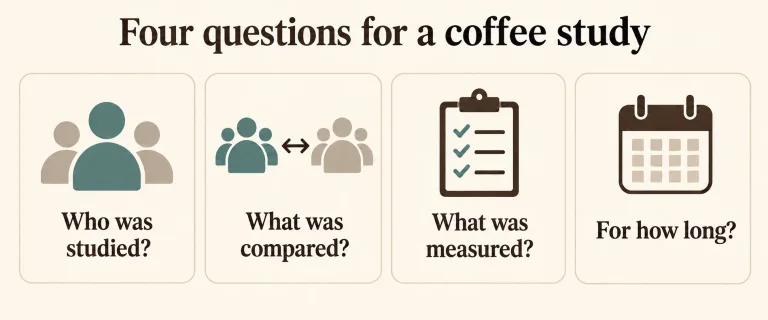
For any new headline, ask four things: who took part, what was compared, what was measured and for how long? An answer about a laboratory marker or a two-week change should not become a promise about years of disease risk.
Sleep deserves as much attention as alertness
Feeling that coffee has worn off does not mean all its caffeine has left your body. CDC/NIOSH gives a typical half-life of five to six hours, with a much longer duration in some people. Half-life means the time needed to eliminate half, not all, of a dose.
That makes the final caffeinated drink worth checking when sleep suffers. NIOSH recommends avoiding caffeine for several hours before sleep, adjusted for individual sensitivity. A universal “safe after this time” rule would hide those differences.
The sleep adjustment below gives you a practical starting point. Our caffeine guide explains drink estimates and timing in more detail.
Blood sugar, reflux and heart symptoms need context
For people managing diabetes, coffee is not a treatment. The CDC notes that caffeine can raise some people's blood sugar, including from unsweetened coffee. Lower insulin sensitivity is not a benefit: the body responds less effectively to insulin. Do not change medication because a population study links coffee with lower diabetes risk.
Reflux triggers differ between people. NIDDK includes coffee and caffeine among commonly reported triggers and recommends discussing suspected foods or drinks with a clinician. A smoother flavor, milk addition or “low acid” label does not establish that a drink will resolve your symptoms.
Do not assume a racing or irregular heartbeat is merely a coffee problem. MedlinePlus advises medical evaluation for new or different palpitations. Palpitations with chest pain, shortness of breath or feeling faint require urgent help; in the US, call 911.
A specific next step when coffee does not agree with you
Use the distinction that matches your concern. These are modest routine adjustments or reasons to seek care, not instructions to provoke symptoms or test a medical condition.
- Sleep worsens after afternoon coffee. Distinguish a late drink from simply counting daily cups. Move that drink earlier, following the NIOSH timing guidance above. Keep your usual bedtime reasonably consistent and watch for easier sleep onset or fewer awakenings. Persistent sleep problems warrant professional advice.
- You feel jittery after a larger serving. Note the serving and other caffeine sources. Choose a smaller caffeinated portion next time and watch whether the jitters recur. The FDA advises discussing caffeine symptoms with a health professional; routine reductions are best made gradually.
- You suspect coffee triggers reflux. Distinguish a repeated pattern from one uncomfortable day. Discuss reducing or avoiding the suspected drink with your clinician, as NIDDK recommends, and record whether symptoms improve during that change. Do not substitute a different roast and assume the problem is solved.
- Your glucose readings rise after unsweetened coffee. Sugar in the cup is not the only possibility. If you already monitor glucose, ask your diabetes team how to compare readings around coffee within your care plan. Record the drink and readings for that discussion; do not adjust medication on your own.
Include what you put in the cup
A coffee order includes its milk, syrup and toppings. The FDA's added-sugars guidance distinguishes added sweeteners from sugars naturally present in foods such as milk. Added sugars are already included in total sugars; do not add the two label figures together.
Check the serving size before comparing creamers. As a label-reading example, if one serving is 1 tablespoon and you use 2 tablespoons, you use two label servings. Double that product's listed calories and nutrients. This is arithmetic, not a suggested portion.
You do not have to drink coffee black. Our black coffee versus milk coffee guide compares exact US labels and measured additions. For butter or oils, the keto coffee guide separates ingredient nutrition from claims about an entire diet.
Keep a useful record without turning coffee into a project
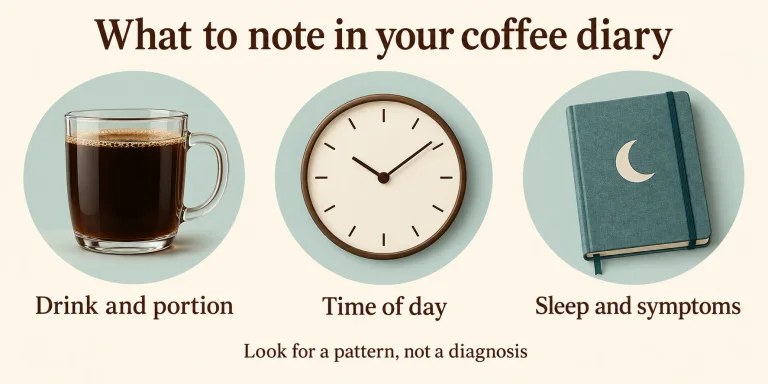
If a pattern needs clarifying, a brief note on your phone is enough. Record the drink and portion, its time, and the outcome that concerns you. For a café order, include the size and number of shots; for home coffee, use the same mug and note how full it is.
A useful entry might say “one usual mug after lunch; took longer than usual to fall asleep.” It is still an observation, not proof of cause. Other changes in sleep, meals, stress or medication may matter, so include obvious differences when discussing a recurring problem with a clinician.
Frequently asked questions
Should I start drinking coffee for its health benefits?
These findings do not establish a need to start. Choose coffee for enjoyment and how it fits your routine; an observational association is not a prescription.
Is 400 mg of caffeine a daily target?
No. The FDA describes 400 mg per day as an amount not generally associated with negative effects for most adults. It is not a target or a personal guarantee. Pregnancy, breastfeeding, medications and health conditions call for individual advice.
Does decaf avoid every downside?
No. The FDA reports roughly 2–15 mg of caffeine per 8 US fl oz of decaf. It can reduce caffeine exposure, but a switch does not guarantee that reflux or another symptom will disappear. Our decaf coffee guide covers the choice in more detail.
Do I need a scale or wearable to follow this guide?
No. You can compare a consistent mug, your drink's timing and a simple written sleep note. For approximate milk portions, a standard US measuring tablespoon is about 15 mL and a teaspoon about 5 mL, following NIST household measures. Use measuring spoons, not an unspecified eating spoon. These measures do not reveal a drink's caffeine content.
How this guide was researched
We checked the original NIH–AARP abstract, the CRAVE paper and trial record, and public health guidance on October 8, 2026. This is a research-based guide; Coffee Corner did not conduct brewing, physiological or clinical tests. The selected studies are not a systematic review, and this article has not received independent clinical review. All three illustrations were created with AI.