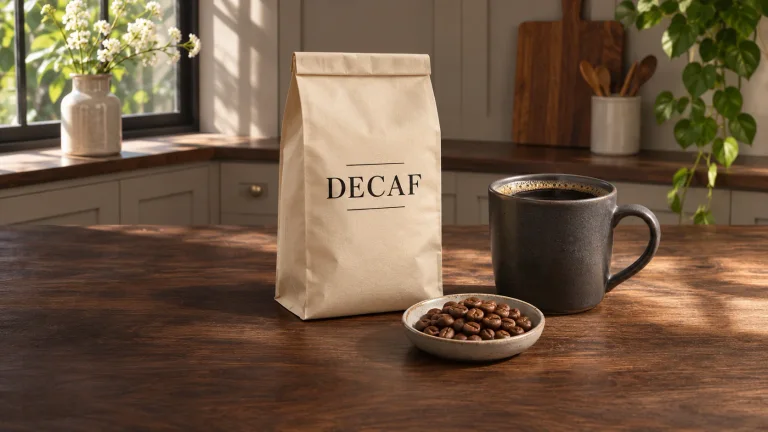
Decaf is useful when you want coffee with much less caffeine. Choose a bag whose process is clearly identified, check the serving behind any caffeine figure, and brew it with a repeatable recipe. The process name helps you understand how the beans were treated; it doesn't tell you exactly how much caffeine is in your mug or whether you'll enjoy the roast.
Use this Coffee Corner guide to read a decaf label and work out what a serving estimate means. If you're comparing drinks beyond decaf, our caffeine reference covers the broader serving differences.
How much caffeine is in a serving?
The FDA gives a typical range of 2–15 mg per 8 US fluid ounces of decaf coffee. That's a reference range, not a promise about every bag, espresso shot or café order. If you react strongly to caffeine, even decaf may be unsuitable.
For coffee poured from the same well-mixed batch, the amount scales with the portion. These calculations show what different servings would contain if that batch were within the FDA range:
| Coffee consumed | Calculation | Illustrative caffeine |
|---|---|---|
| 8 US fl oz | One reference serving | 2–15 mg |
| 12 US fl oz | 1.5 × the reference serving | 3–22.5 mg |
| 16 US fl oz | 2 × the reference serving | 4–30 mg |
| Two 16 US fl oz servings | 4 × the reference serving | 8–60 mg total |
Use a product-specific figure when available. These are arithmetic examples, not measurements or guaranteed limits. A differently brewed batch may have a different concentration.
Milk and water can make a drink taste milder without removing caffeine already in it. For example, adding milk to a fixed portion of coffee increases the drink's volume; it doesn't subtract caffeine from that portion. Likewise, a large decaf latte needs information about its espresso shots, not a calculation based on the finished cup's milk-filled volume.
 AI
Four questions to ask of a decaf label
- Is it decaf, half-caf or a low-caffeine blend? Those descriptions aren't interchangeable. A blend may contain regular coffee even when its packaging emphasizes a decaf process.
- Which process was used? Look for a named water process, ethyl acetate, methylene chloride or CO₂. If the bag doesn't say, check the roaster's page for that exact coffee or ask before buying.
- What does the caffeine number describe? A result for green beans, a percentage by dry weight and milligrams in brewed coffee answer different questions.
- Does the serving match yours? Look for the amount of coffee used, brewing method and drink volume. A number with none of that context isn't enough to estimate your cup confidently.
For mushroom blends, use our mushroom-coffee guide to check whether the exact product contains coffee and what its serving information says.
Also check the roast description and grind option. Someone buying grounds for a drip machine needs a different preparation from someone using an espresso machine. Start with a small bag so you can decide whether the coffee suits your usual recipe before committing to a larger order.
Keep a simple note: coffee name, process, roast date if supplied, recipe and serving size. Photographing the package is useful when a listing changes or you want to reorder the same coffee. You don't need a lengthy tasting journal to remember which bag worked for you.
What the process names mean
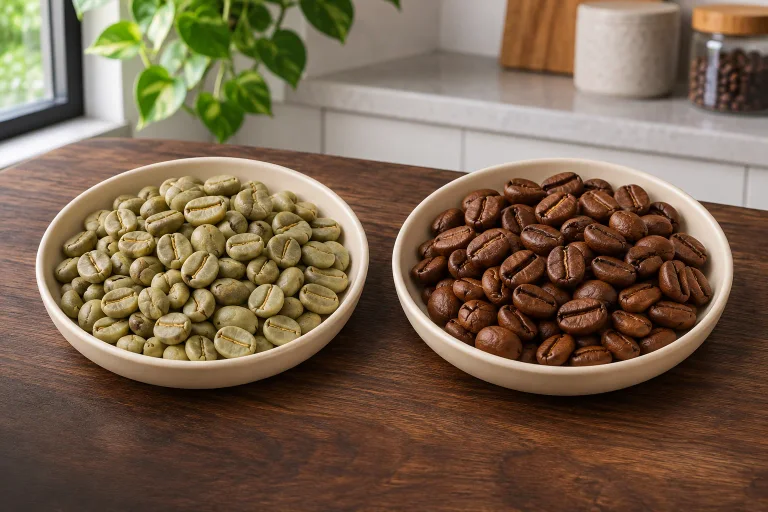
Decaffeination normally happens to green, unroasted coffee. Roasting and brewing come later. The following descriptions identify the extraction approach; none establishes a universal taste ranking.
| Label wording | What happens | Useful buying check |
|---|---|---|
| Water process | Water-based extraction and filtration remove caffeine. In the Swiss Water process, hydrated beans contact green coffee extract, and carbon filters remove caffeine from the circulating liquid. | Identify the processor. “Water process” doesn't automatically mean the Swiss Water brand. |
| Ethyl acetate, EA or sugarcane process | Coffein Compagnie describes steam preparation, extraction with water and ethyl acetate, then steaming and drying. | EA can be naturally sourced or synthesized. Ask for the actual process description if the origin matters to you. |
| Methylene chloride or dichloromethane | Coffein Compagnie's process uses a water–solvent mixture to extract caffeine, followed by steam treatment and drying. | Choose a clearly identified alternative if you prefer to avoid this method; an unspecified “natural” claim doesn't identify the solvent. |
| CO₂ process | CR3's Carbonic Natural process circulates liquid carbon dioxide through moistened beans, separates the caffeine, then recirculates the CO₂. | Check the named processor. This describes CR3's liquid-CO₂ method, not every industrial CO₂ process. |
“Sugarcane” describes the process ingredient's origin; it doesn't mean the bag contains sweetened coffee. Read any separate flavoring or ingredient information. Likewise, marketing language about a “chemical-free” process is not a caffeine measurement or a health comparison.
 AI
Why a percentage isn't a mug measurement
Read what the percentage is of. “Caffeine removed” compares the amount before and after processing. “Caffeine-free by dry weight” describes the composition of the beans. Those are different denominators.
For example, roaster DEKÁF describes Swiss Water beans as at least 99.9% caffeine-free by dry weight. That wording does not mean a brewed cup has exactly 0.1% of the caffeine in an ordinary cup. As a purely mathematical illustration, 0.1% by mass equals 1 mg per gram of dry material; it still isn't a measurement of what brewing extracts into a drink.
Swiss Water itself explains that the final cup varies with preparation and the amount of coffee used. If you need a specific caffeine limit, ask for information about the finished drink under a stated recipe. Don't turn a bean-processing percentage into a precise cup estimate.
Half-caf and diluted coffee: count what you use
Half-caf can help you reduce caffeine without switching entirely to decaf, but the name doesn't supply a fixed milligram value. For a blend, ask what the roaster means by the ratio and whether it provides caffeine information for a stated serving.
For equal volumes of already brewed coffee, the calculation is straightforward. Suppose a hypothetical regular coffee contains 100 mg per 8 fl oz and a hypothetical decaf contains 4 mg per 8 fl oz. Mixing 4 fl oz of each gives:
That's a worked example, not a value for a commercial half-caf blend. Mixing dry beans changes the preparation, and unknown starting values remain unknown. The caffeine calculator can help organize estimates; it cannot measure your coffee.
Brew it normally, then fix a specific problem
Start with the roaster's recipe for your brewing method. Note the dose and water amount so you can repeat the recipe. Keep coffee sealed in a cool, dry place and grind near brewing when practical, following the Coffee Association of Canada's storage and brewing guidance. Our whole-bean and preground guide helps you choose the format that fits your routine.
For a cone pour-over, the following comparisons follow Baratza's grind and flow guidance. Keep the rest of your recipe steady during each comparison.
Slow drainage and a heavy, unpleasant cup: if the filter is seated correctly and the brew is stalling, try one small grind adjustment coarser. Observe whether drainage improves without losing the flavor you liked. A slow brew that tastes good doesn't need fixing just for the timer.
Fast drainage with a sharp, underdeveloped cup: try one small adjustment finer. Look for a rounder flavor without creating a stall; speed alone isn't a defect.
Flow becomes very slow after vigorous pouring: keep the grind and dose, but pour more gently with the spout nearer the bed. Observe whether the later pours drain more consistently. This checks agitation before another grind change.
Decaf doesn't always need a finer grind, a coarser grind or a special temperature. Let the problem in your cup guide the adjustment. Our troubleshooting guide covers other methods and problems such as dirty equipment.
What switching to decaf does—and doesn't—change
Switching reduces caffeine; it doesn't make every coffee-related issue disappear. NIDDK lists coffee and caffeine among commonly reported reflux triggers. If symptoms persist, discuss your usual drink and serving with your clinician.
Brewing method also matters. The American Heart Association links cafestol in regular and decaf coffee with increased LDL cholesterol and distinguishes unfiltered coffee from paper-filtered coffee. If you're managing cholesterol, include preparation method in that discussion.
Health headlines aren't a reason to start drinking coffee or replace treatment. The National Cancer Institute explains why dietary associations alone don't establish cause and effect. For pregnancy, breastfeeding, medication use or a prescribed caffeine restriction, get advice about your individual limit rather than treating “decaf” as permission for unlimited servings.
Decaf FAQs
How can I check my serving without a scale?
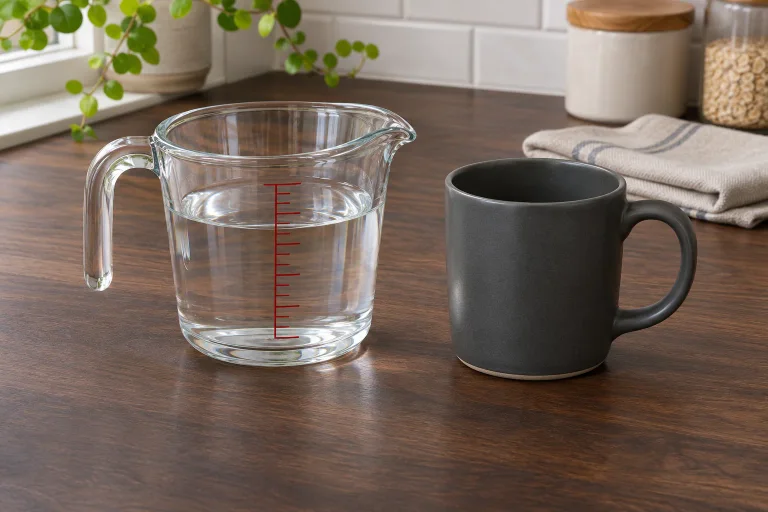
Fill your empty mug with cool water to your usual coffee level, then pour that water into a kitchen measuring jug marked in US fluid ounces. Read it on a level counter. This estimates the volume you drink; it doesn't measure caffeine. A US measuring cup holds 8 fl oz, but your drinking mug may hold more.
How much ground coffee can I use without weighing it?
For an approximate ordinary drip starting point, the Coffee Association of Canada gives 1–1.5 tablespoons per 6 fl oz of water. Use a level US measuring tablespoon, about 15 mL. For 12 US fl oz of water, that's 2–3 level tablespoons. Follow your brewer's batch and basket limits, and use the roaster's directions when supplied. Spoon volume varies with the grounds; this is not a grams conversion or an espresso recipe.
Can I use regular beans and remove the caffeine at home?
The processes above treat green beans before roasting. They aren't instructions for rinsing roasted grounds or discarding part of a brew. Buy coffee identified as decaffeinated when that is your goal.
Can I drink decaf right before bed?
It reduces the caffeine involved, but doesn't guarantee undisturbed sleep. Keep track of the serving and time if you're comparing routines. Our coffee timing guide explains how timing and individual response complicate a universal cutoff.