
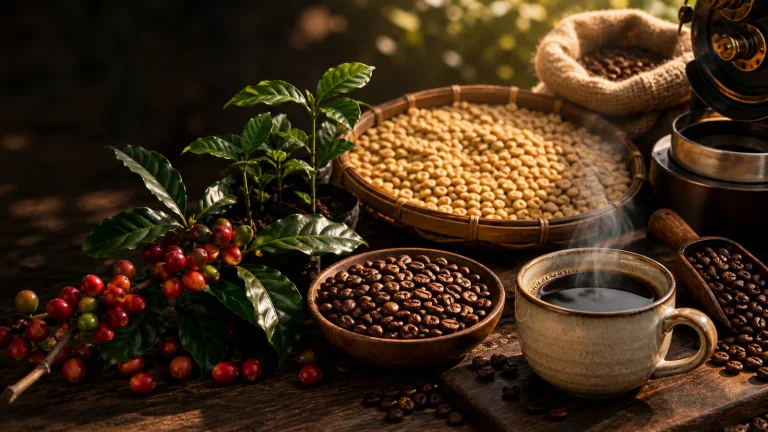
Coffee flavor comes from the whole production chain: the plant and place, the way the fruit is processed, the roast, and finally your brew. If you're choosing a bag, start with the flavors you enjoy, then read its origin, process and roast together. Light and dark describe roasting, not quality or how concentrated your drink will be.
Follow the journey below, or jump to the roast comparison and brewing adjustments. This is Coffee Corner's guide to how those choices connect.
Follow the seed from the nursery through harvest and processing to the roaster and your brewer.
- Nursery
Seeds are selected, germinated, and raised before field planting.
- Cherry
Ripe fruit carries the two green seeds most drinkers call beans.
- Harvest
Selective picking gives cleaner lots than stripping ripe and unripe fruit together.
- Process
Washed, natural, and honey methods shape sweetness, acidity, and body.
- Dry
Slow, even drying protects the seed and keeps mold or fermentation faults away.
- Mill
Hull, sort, grade, and prepare green coffee for export.
- Roast
Heat turns green coffee into aromatic roasted coffee.
- Grind
Fresh grinding controls extraction speed and clarity.
- Brew
Water, ratio, time, and temperature decide what finally lands in the cup.
Where coffee grows
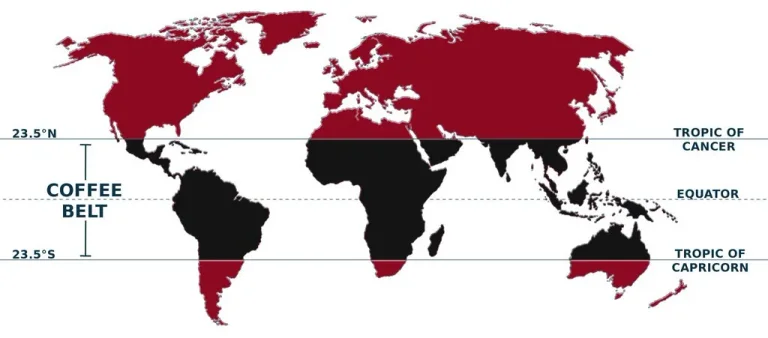
Most coffee is grown inside the "coffee belt," the band of tropical and subtropical regions between the Tropics of Cancer and Capricorn. The major producing regions are Latin America, Africa, and Asia-Pacific, but the taste of a coffee is more specific than a continent. A shaded hillside in Colombia, a washing station in Ethiopia, a volcanic region in Guatemala, or a Robusta farm in Vietnam can each point the cup in a different direction before a roaster touches it.
Arabica generally dominates the specialty conversation because it can show more delicate acidity, florals, fruit, and sweetness. Robusta is hardier, usually higher in caffeine, and widely used in espresso blends, instant coffee, and regions where yield and disease resistance are central. The global market needs both. The USDA Coffee: World Markets and Trade report tracks production, exports, consumption, and stocks by origin, while the International Coffee Organization follows monthly export and market movement.
Seedlings and farm choices
A coffee farm often begins with nursery work. Seeds from selected trees are germinated, protected, and moved into bags or beds until they are strong enough for field planting. The farmer is not simply growing "coffee." They are choosing varieties, spacing, shade, soil care, disease management, and harvest strategy years before a drinker tastes the result.
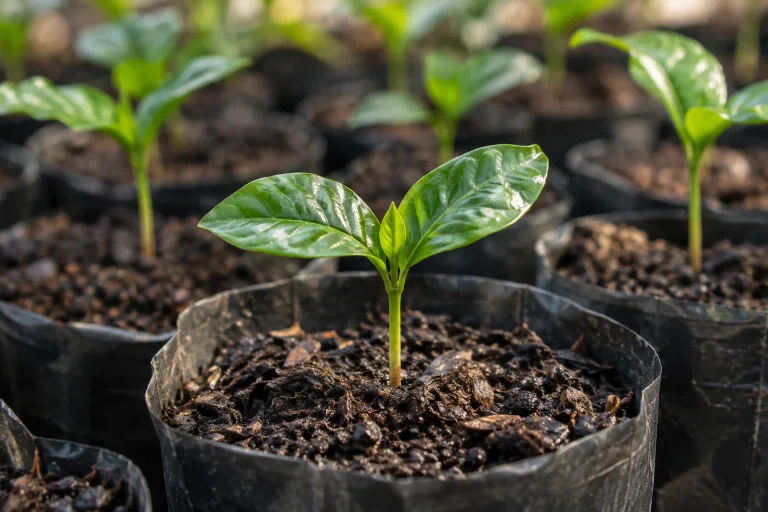
A newly planted coffee tree does not produce a meaningful crop immediately. It needs time to establish roots and structure. That long horizon is one reason coffee farming is risky: a decision made today can shape quality and income several seasons later.
Harvesting cherries
As the NCA explains in its harvesting overview, selective picking and strip picking collect fruit differently. Coffee fruit ripens unevenly. A branch can hold green, yellow, orange, and deep red cherries at the same time, and that makes harvesting one of the most important quality gates in the whole chain. Ripe cherries usually carry more sweetness. Under-ripe fruit can taste grassy or peanut-like. Overripe fruit can become boozy, fermenty, or muddy.
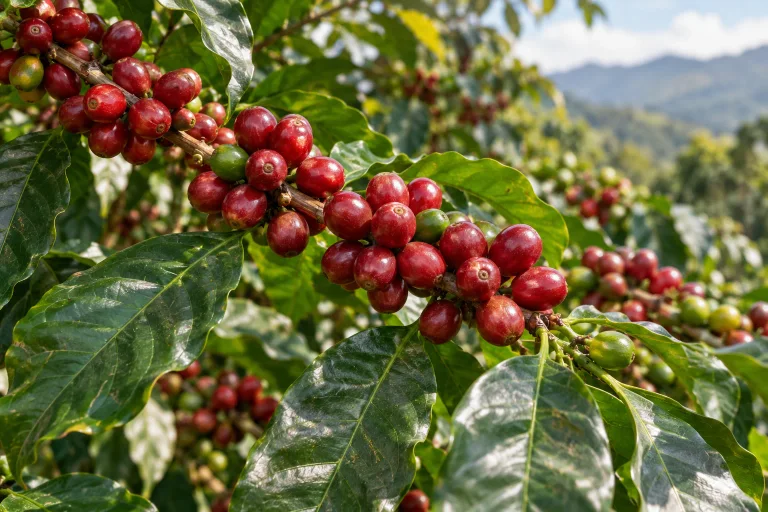
Selective hand-picking costs more because workers return to the same tree several times as cherries ripen. Strip picking is faster and cheaper, but it can mix ripe and unripe fruit unless the sorting afterward is very good. Mechanized harvesting can work well in flatter regions and larger farms, though it also depends on timing, equipment setup, and post-harvest sorting.
Pickers choose ripe cherries and return for fruit that needs more time.
Fast and efficient, but it needs stronger sorting to remove green or damaged fruit.
Useful at scale where terrain allows machines and processing can catch defects early.
Processing: washed, natural, and honey
Processing is the step where the fruit becomes a stable seed that can travel. It is also one of the easiest places to understand why coffees taste different. Common approaches include washed, natural and honey processing; the NCA processing guide explains how much fruit remains during drying.
| Method | What happens | Typical cup direction | Risk if mishandled |
|---|---|---|---|
| Washed | Fruit is removed, mucilage is broken down or washed away, and the seed is dried. | Cleaner acidity, clearer origin notes, lighter body. | Sourness, flatness, or water waste if managed poorly. |
| Natural | Whole cherries dry with fruit still around the seed. | More fruit, heavier sweetness, bigger body. | Fermenty, moldy, or uneven flavors if drying is careless. |
| Honey | Skin is removed, but some sticky mucilage remains while drying. | Variable: it can resemble washed or natural coffee, depending on the process. | Uneven drying or sticky-bed fermentation faults. |
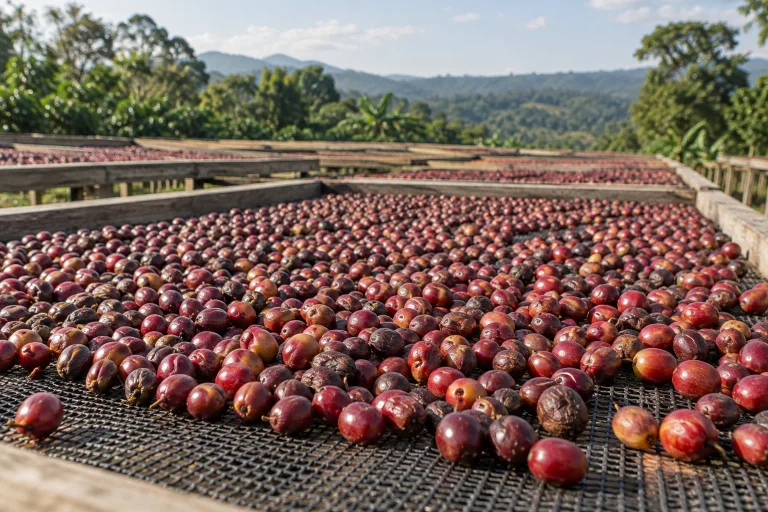
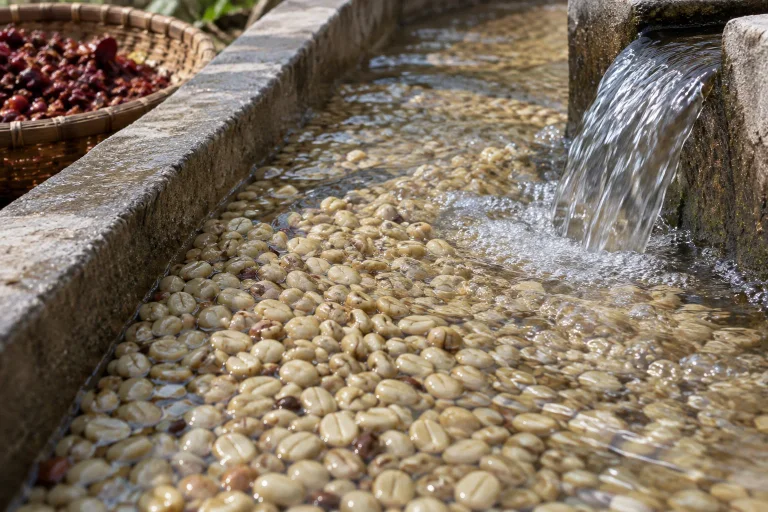
No process is automatically better. A precise washed coffee can taste transparent and elegant. A careful natural can taste like berries and chocolate. A careless version of either can taste rough. The better question is whether the farm, mill, and exporter controlled the process well enough to protect the coffee.
The fruit side of coffee does not always disappear after processing. In some producing regions the dried cherry husk becomes cascara, a lightly caffeinated coffee-cherry infusion that tastes more like fruit tea than brewed coffee. It is a useful reminder that the coffee plant gives us more than the roasted seed.
Drying, milling, and grading
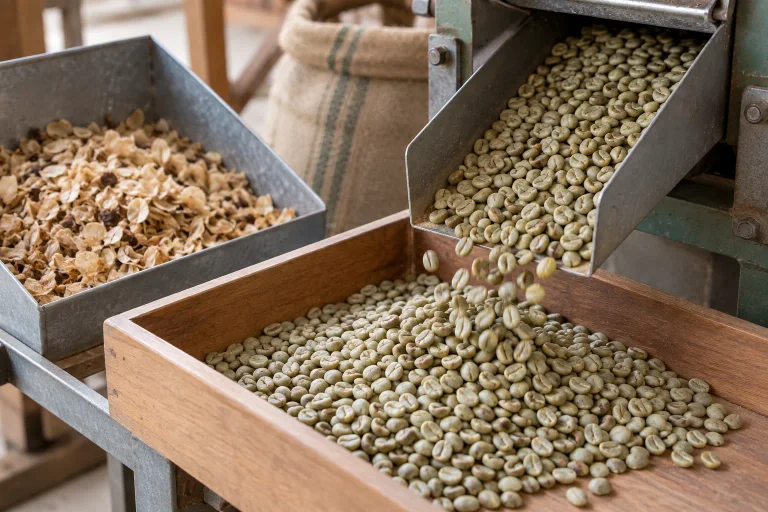
After processing, coffee must dry to a stable level before storage and export. Drying and storage need careful control to avoid spoilage. Producers use patios, raised beds, mechanical dryers, or combinations depending on climate, volume, and resources.
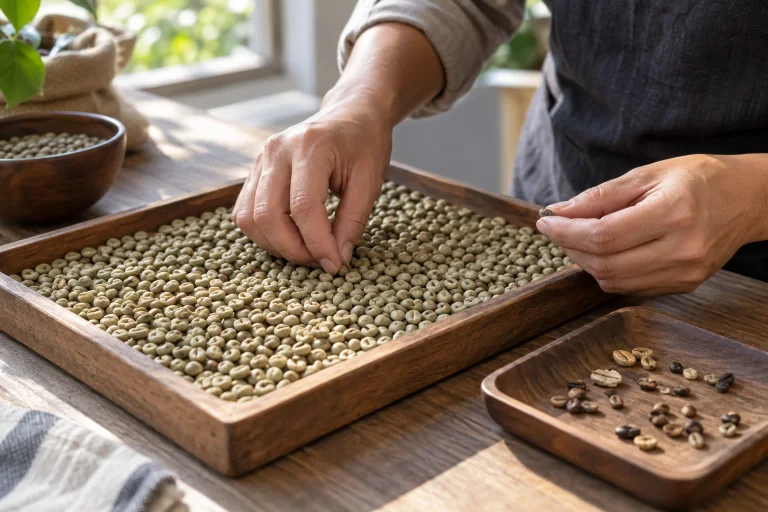
Once dried, coffee is hulled to remove parchment or dried fruit layers, then sorted by size, density, color, and visible defects. The FAO's overview of green-coffee grading illustrates how defect and size classifications work. The Specialty Coffee Association's Coffee Value Assessment separates physical assessment from descriptive sensory assessment, because a clean-looking green coffee still has to taste good.
Cupping decides whether the lot works
Cupping is the tasting protocol used to evaluate aroma, flavor, acidity, body, balance, sweetness, and defects. It is not meant to be the most delicious way to drink coffee. It is a repeatable way to compare coffees side by side.
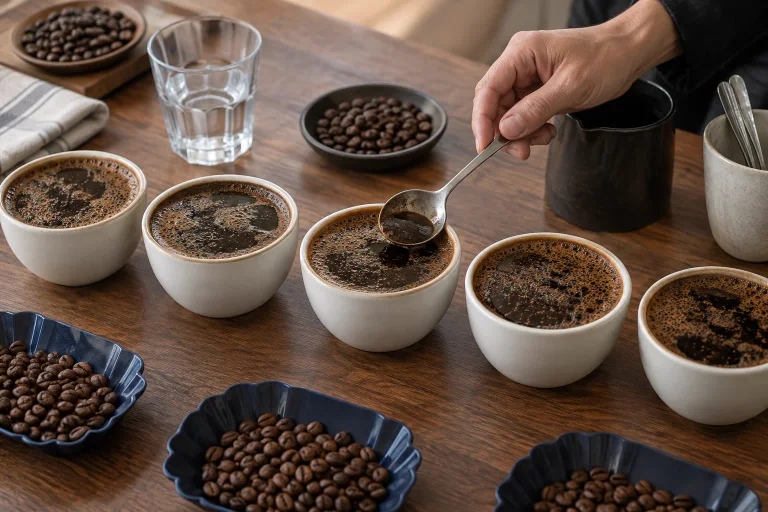
For readers buying beans, tasting notes help describe the intended flavor. A bag listing jasmine, citrus and black tea promises a different direction from one listing dark chocolate, hazelnut and molasses. Those descriptions can guide a choice; they do not guarantee what every drinker will taste.
Roasting changes chemistry, not origin
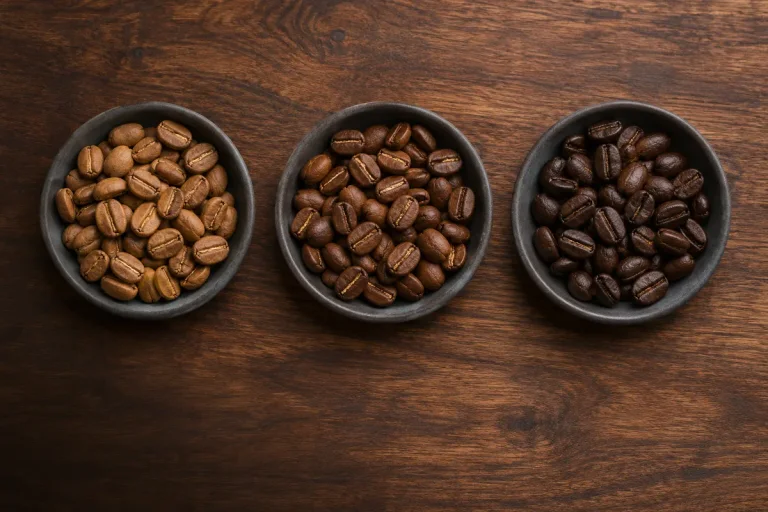
Roasting turns hard, grassy-smelling green coffee into the aromatic brown beans you grind. Heat changes the seed's color, structure and flavor. It doesn't change where the coffee grew or how the fruit was processed. Read those parts of the label together: a natural Ethiopian light roast and a washed Colombian light roast needn't taste alike.
Light, medium and dark are useful directions, not interchangeable specifications. The National Coffee Association's roast guide notes that one roaster's dark can differ from another's. Some roasters give a measured color value too: Counter Culture explains its Agtron scale, on which lower numbers mean darker coffee. Compare labels within a roaster's range first, then use the tasting notes to narrow your choice.
 AI
Light roast vs dark roast: choose the flavor first
Neither end of the roast range is a quality grade. Use this comparison to decide what to try; origin, processing and the individual roast still matter.
| Roast | Broad tendency | Try it when… | Check before buying |
|---|---|---|---|
| Light | Less roast flavor; origin characteristics and acidity tend to be more apparent. | You want to explore the coffee's fruit or floral notes. | Do the listed flavors sound appealing, including the citrus or berry notes? |
| Medium | A middle position between lighter and darker roasting, with plenty of variation. | You want to compare both directions without starting at an extreme. | Read the roaster's description rather than assuming every medium tastes the same. |
| Dark | More pronounced roast flavor and bitterness, with less perceived acidity. | You enjoy a roast-forward cup. | Distinguish a moderately dark roast from a much darker French or Italian roast. |
You can brew any of these in a drip machine, pour-over or espresso machine. “Espresso roast” describes a roaster's intended use, not a separate coffee species or a fixed roast level. Start with the bag's recipe when one is provided. A preference for dark coffee doesn't require buying a different brewer.
Roast flavor, brew strength and caffeine are different questions
A smoky coffee can be diluted; a light roast can be brewed concentrated. In brewing research, strength means the concentration of dissolved coffee, rather than how dark the beans look. A UC Davis study of drip coffee varied roast, concentration and extraction separately and found that several taste attributes responded to more than one factor. “Strong” on a bag doesn't tell you all three.
Don't use roast color to estimate caffeine in your mug. The amount of coffee, beans used, brewing method and serving size all matter; equal scoops and equal weights aren't the same comparison. Our caffeine guide covers serving estimates and their limits. For buying bags rather than interpreting labels, see Coffee Corner's coffee bean guide.
Grinding and brewing: where the reader takes over
Once the bag reaches your kitchen, you control the grind, dose, water and brewing method. Keep a familiar recipe for the first cup from a new bag. That gives you a reference point before you decide the roast is wrong for you. Counter Culture's brewing guidance recommends starting taste adjustments with grind size; its general hot-brewing range is 195–205°F (about 91–96°C).
Try the same bag twice
- Write down the bag and your usual recipe. Note the roast description, process, grind setting, coffee amount and water amount. Keep the brewer, filter and water source the same for the repeat.
- Name the problem in the first cup. Is it sharp and thin, dry and bitter, or pleasantly flavored but too weak? Taste when it's comfortable to sip; don't compare one scalding cup with another that's cooled.
- Use the matching adjustment below. Record just that change for the second brew. Note whether the unpleasant quality recedes and whether you still like the remaining flavor.
- Choose the next bag from that result. If the brew improves but its bright fruit character still isn't for you, look for a different profile. If you miss that brightness after moving darker, try a lighter option again. You don't have to train yourself to like every roast.
This is a way to make your own preference clearer, not a blind test proving one roast superior. To explore the same coffee at different roasts, ask a roaster whether it offers the same lot roasted two ways. Otherwise, changing bags also changes other parts of the production chain.
Troubleshooting after switching roasts
For filter coffee, the grind adjustments below follow Broadsheet Coffee Roasters' brewing guidance. Use the taste comparison to decide whether they help, rather than diagnosing every sour cup as under-extracted or every bitter cup as over-extracted.
| Symptom | Useful distinction | Next adjustment | What to observe |
|---|---|---|---|
| Sharp and thin | A harsh, hollow cup is different from fruit-like brightness you enjoy. | Grind a small step finer for the next filter brew. | Does the cup become rounder without a dry finish? If it improves but remains too bright for you, change the flavor profile next time you buy. |
| Bitter with a drying finish | Separate an unpleasant finish from the roast flavor you deliberately chose. | Grind a small step coarser. | Does the drying sensation ease? If the dominant roast flavor still bothers you, a lighter bag is a more useful next trial. |
| Thin, but otherwise pleasant | Low concentration isn't the same problem as harsh sourness. | Use slightly less brewing water for the same coffee dose. | Does the flavor gain enough presence? Use the ratio calculator to keep the change repeatable. |
If coffee is sour and bitter together, or changes dramatically between identical brews, use our fuller coffee troubleshooting guide before buying another bag. For flat or stale coffee, check storage and when you grind.
Roast and production FAQs
Can I compare roasts without owning a grinder?
Yes. Buy coffee ground for your brewing method and compare bags using the same recipe. You won't be able to make the grind adjustments above with that bag, so ask the roaster for a different grind next time if the brew consistently needs it. For example, Counter Culture lists pre-ground options at grocery retailers.
Is a natural-process coffee the same as a light roast?
No. Natural describes drying the coffee with the fruit attached; light describes roasting later in the chain. A natural coffee can be roasted darker, and a washed coffee can be roasted lighter. Read both terms before deciding what you expect from the bag.
Set dose and water before brewing.
Experiment Cold Brew GuideUse extraction time instead of heat.
Choose gear Coffee Maker QuizMatch the machine to your routine.
Why this process matters
A bag's price alone cannot tell you how well the coffee was grown or whether the flavor suits you. Look for useful production information and a roast description you understand. Then use your brew notes to choose the next bag with more confidence.
Keep the label from a bag you liked, along with a short brew note. On your next purchase, that record is more useful than trying to remember whether the last coffee was simply “strong” or “smooth”.