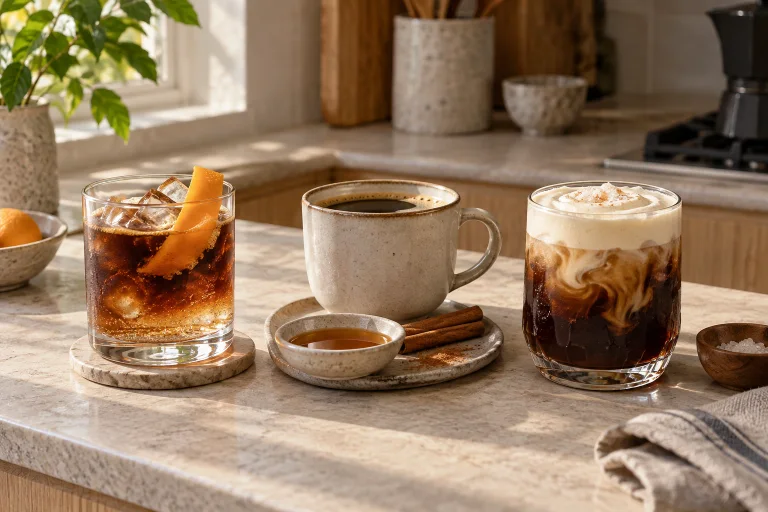
The coffee maker has no single inventor. Its history is a series of practical changes: separating grounds from the drink, making water move through coffee, controlling pressure, and handing more of the work to a machine. A cezve, French press and automatic drip brewer are different answers to those problems—and all still have a place in the kitchen.
Follow the milestones below to see how those ideas developed. The dates identify particular designs, documents or launches; a patent for an improvement does not mean nobody brewed that way before.
Coffee maker history at a glance
- Before electricityCoffee in a potHeat, finely ground coffee and a careful pour.
- 19th centuryThe vacuum brewerTwo chambers turn pressure changes into movement.
- 1889Goodrich’s percolator patentA tube and basket circulate hot water.
- 1905La Pavoni’s IdealeCommercial espresso takes shape.
- 1908Melitta’s paper filterA disposable barrier keeps grounds out.
- 1928–1931A documented plunger designA sliding filter separates an immersion brew.
- 1933The Moka Express designStovetop pressure moves water through coffee.
- 1941CHEMEXThe brewer and serving vessel become one.
- 1947–1961Levers, then pumpsEspresso pressure gets its own mechanism.
- 1960s–1970sElectric drip brewingThe appliance heats and delivers the water.
- 2005AeroPressManual brewing finds another form.
Before electricity: coffee in a pot
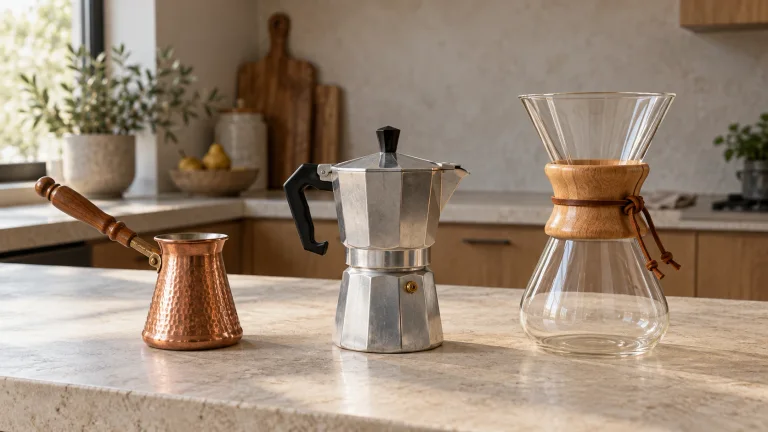
A brewer does not need a pump, paper filter or even a separate serving vessel. The Turkish coffee tradition illustrates that older approach: finely powdered coffee is heated with water in a small pot, then served without filtering away the grounds. UNESCO’s account of Turkish coffee culture describes slow stovetop preparation, foam and small cups, as well as the drink’s social role.
The pot is commonly called a cezve; ibrik also appears in English-language coffee writing. Its long handle lets the brewer manage a small vessel over heat. The grounds remain part of the preparation instead of being caught in a removable basket.
A serving pot, a roasting pan and a grinder do different jobs. Brewing equipment combines coffee with water, then separates—or deliberately retains—the grounds. For the wider story of the drink, continue with our history of coffee.
The 1800s: brewing with two chambers
The siphon, also called a vacuum brewer, makes the movement of water visible. Water starts in the lower chamber. Heating increases pressure there and pushes water into the upper chamber, where it mixes with coffee. Removing the heat reduces pressure below, and the brewed liquid returns through a filter.
HARIO’s history and explanation places the method in nineteenth-century Europe, while acknowledging competing origin accounts. HARIO itself entered coffee equipment with its HIROMU siphon in 1948.
The important idea is a controlled journey between chambers, rather than a pump or a hand-operated plunger. The return stage also separates the finished drink from the grounds. That is why simply describing a siphon as “water rising into coffee” misses half the process.
1889: a percolator you can recognize
Hanson Goodrich’s US patent 408,707, granted August 13, 1889, shows a tube rising from the bottom of a coffee pot to a basket above. Heated water travels up the tube, falls over the grounds and drains into the pot. The cycle repeats.
Goodrich described an adjustable attachment for an existing pot. The adjustable tube let the basket sit at a suitable height inside the pot, turning a familiar vessel into a more specialized brewer.
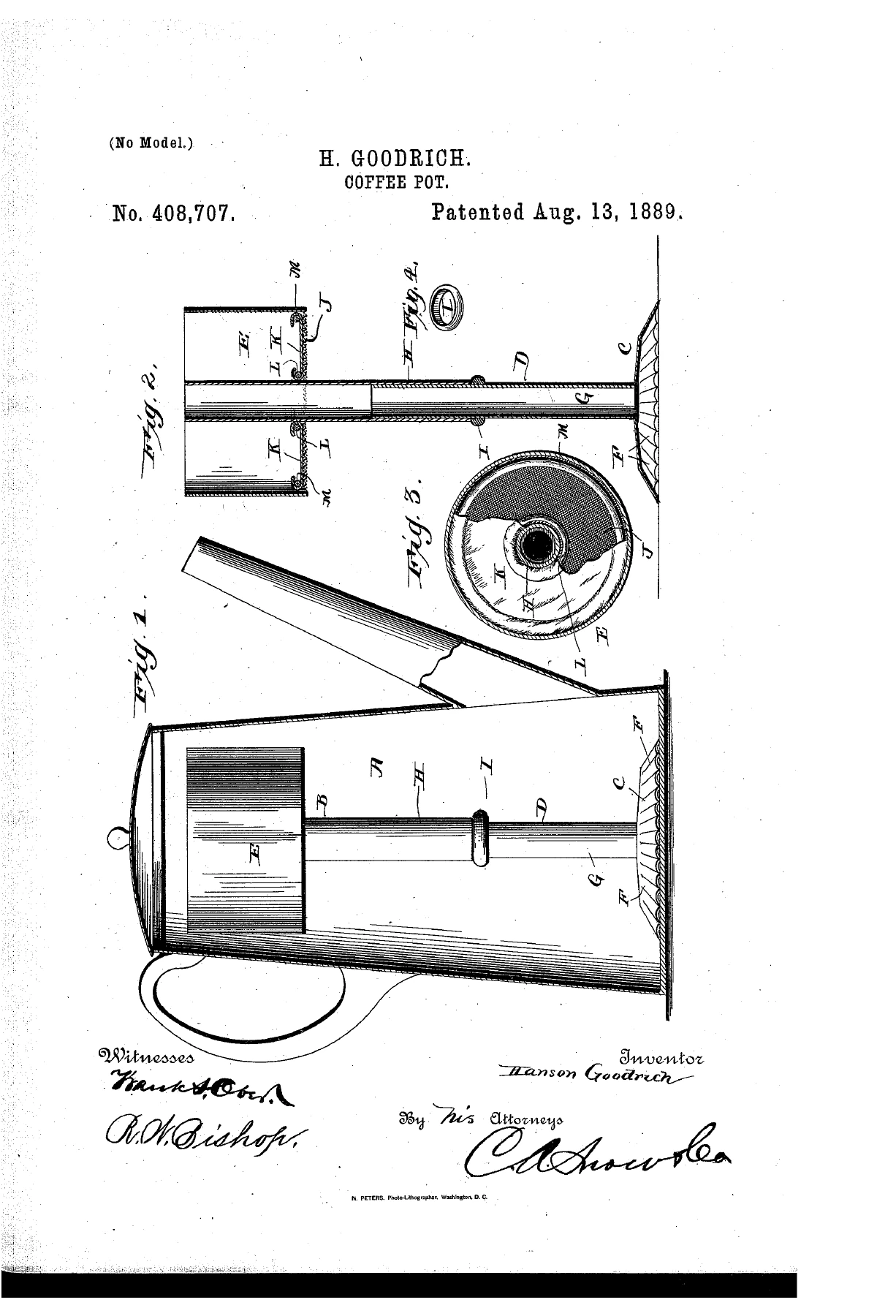
A recirculating percolator differs from a drip machine in one crucial way: liquid returns to the same heated reservoir and can pass through the coffee again. In a drip brewer, water passes through the bed and collects separately. “Percolation” can describe liquid moving through grounds generally, but a percolator is a particular kind of appliance.
1905: espresso becomes a commercial machine
Espresso developed through several inventions, rather than arriving fully formed. La Pavoni dates its founding and the Ideale to 1905. Its historical monograph also records Luigi Bezzera’s earlier work and the transfer of patent rights to Desiderio Pavoni.
These early commercial machines used a heated boiler and steam pressure. Their significance was preparation for service: making coffee for customers with dedicated equipment and a filter holder. They should not be confused with the later high-pressure lever and electric-pump machines.
The familiar silhouette of a café machine can hide that difference. A tall boiler, a group and a handle do not tell you how much pressure reaches the coffee or how the water is heated. Following the mechanism gives a clearer history than calling every old espresso machine the same thing.
1908: Melitta makes paper part of the brewer
Melitta Bentz addressed an everyday annoyance: grounds in the cup. Melitta’s account describes her experiments with a perforated brass pot and blotting paper. The company’s chronology records utility-model protection on June 20, 1908.
The practical change was a disposable filter that retained the grounds while coffee flowed into a vessel below. Cloth and other filtering arrangements already existed; paper was a new answer to the separation and cleanup problem.
Today’s cone filters were not all present in that first design. Melitta’s history dates its familiar filter bags to 1936, showing how an invention can keep changing long after its founding year. The filter shape, holder and outlet form a system: changing one part can alter how water moves through the coffee.
1928–1931: a plunger patent tells a more precise story
The French press combines soaking with a movable filter. Coffee and water share a vessel; pushing the filter downward holds much of the solid material beneath it while the drink is poured.
One particularly clear document is US patent 1,797,672. It names Ugo Paolini as inventor and Attilio Calimani and Giulio Moneta as assignees. The document records an Italian application on April 2, 1928, a US filing on April 2, 1929, and a US grant on March 24, 1931.
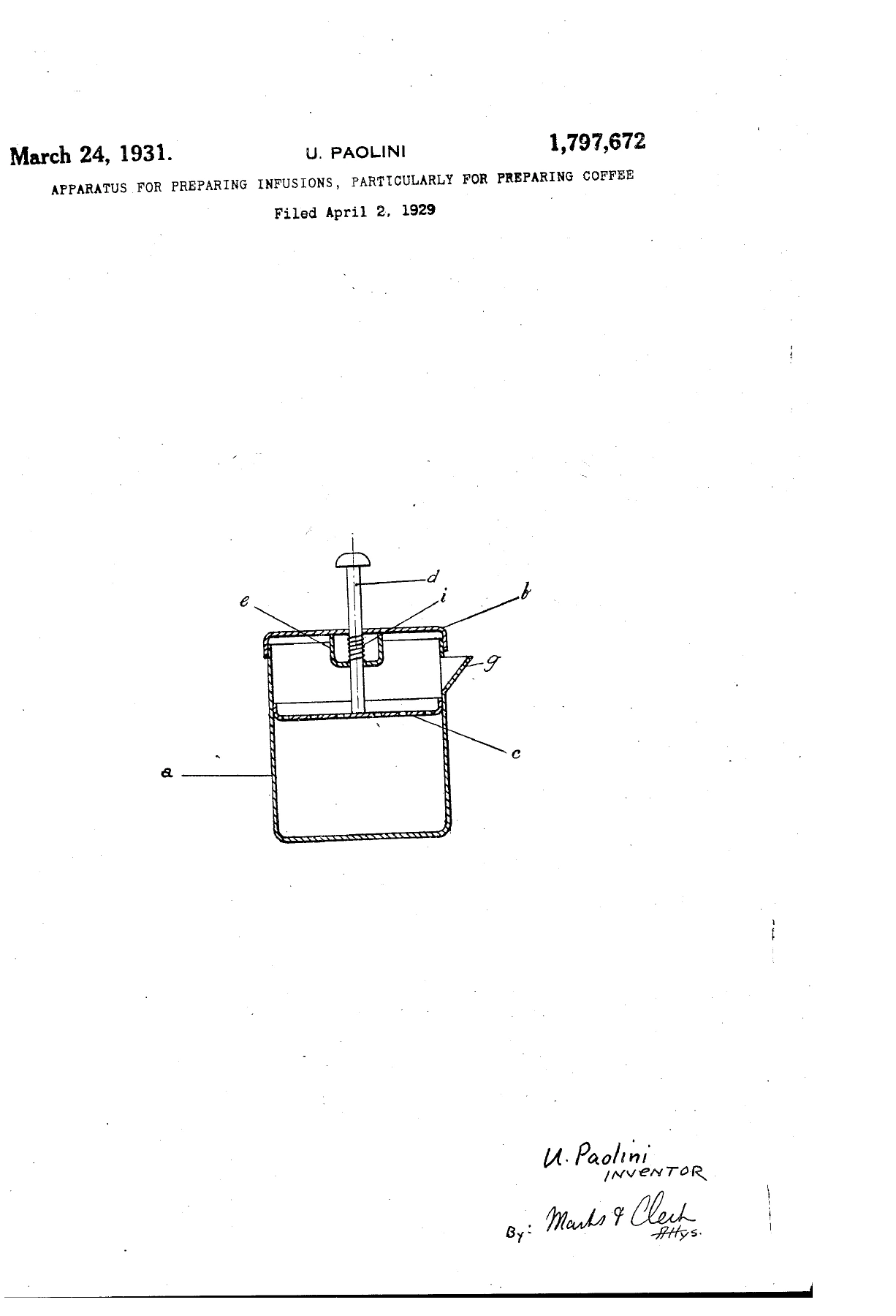
That sequence explains why different dates appear in short histories. An application, a granted patent and a product launch are not interchangeable. The drawing shows a recognizable immersion-and-filtering arrangement. To use the modern version, follow our French press recipe.
1933: the Moka Express brings pressure to the stove
MoMA dates the Moka Express design to 1933, attributing it to Alfonso Bialetti.
The lower chamber holds water, the funnel basket holds coffee, and the upper chamber collects the drink. Heat raises pressure below, driving water through the grounds and into the collector. The compact form puts the heat source outside the brewer, on the stove.
Moka coffee is often called stovetop espresso, but the moka pot and a pump espresso machine use different pressure systems. They should not be treated as interchangeable equipment simply because both make a concentrated drink. Unlike the recirculating percolator, the moka pot collects coffee in a separate upper chamber.
1941: CHEMEX combines brewer and serving vessel
Peter Schlumbohm’s CHEMEX brought a laboratory-inspired shape to the table. The manufacturer dates the design to 1941 and describes the one-piece glass vessel, wooden collar and paper filtration.
The upper cone supports the filter; brewed coffee collects in the lower vessel. There is no separate plastic basket or powered brewing unit to hide the process. The same object moves from preparation to serving, making its shape useful as well as recognizable.
CHEMEX gave pour-over brewing a distinctive physical form: an integrated combination of filter, brewer, handle and carafe. Its continued presence alongside automatic machines also shows that convenience is only one reason people choose equipment.
1947–1961: the lever and the electric pump
Gaggia’s chronology records a lever-piston patent in 1947 and the Tipo Classica machine in 1948. The lever loaded a spring, which drove a piston to pressurize the brewing water. This separated the generation of brewing pressure from reliance on boiler steam pressure.
A further milestone was Faema’s E61 in 1961. MUMAC’s description of its historical E61 identifies an electric pump, water from the supply passing through a heat exchanger, and delivery to the brewing group. The pump took over pressure generation.
For the person behind the bar, those developments changed the work as well as the cup. Pulling a spring lever and operating a pump-driven group are different routines. Modern espresso machines still reflect these choices, even when electronic controls make the underlying mechanism less visible. Our guide to the most expensive coffee machines shows how far the equipment has developed.
The 1960s and 1970s: the machine takes over the pour
Electric drip brewing mechanized a familiar arrangement: heat water, deliver it above a filter basket, and collect coffee separately below. Melitta’s chronology records its MA 120 electric machine in 1965.
In the United States, Edmund Abel Jr.’s electric coffee-maker patent, filed in 1971 and granted in 1972, documents a pour-in reservoir, heating arrangement and delivery above the coffee. The patent record identifies Mr. Coffee among its assignees.
The practical appeal is easy to recognize: the appliance handles water delivery while the user loads coffee, water and a filter. Automation shifts work rather than eliminating it. Dose, grind, cleaning and the condition of the brewing parts still matter. A timer changes when a machine starts; it does not decide how much coffee belongs in its basket.
2005 onward: manual brewing keeps evolving
More electronics did not end manual invention. Alan Adler introduced AeroPress at Coffee Fest Seattle in November 2005, according to the company’s inventor history. Its chamber, plunger and filter offered another compact way to prepare an individual coffee.
The point is not that every new brewer replaces the previous one. A press gives the user one kind of control; a paper dripper another; an automatic appliance takes over part of the routine. Many kitchens contain more than one because breakfast for a household and a single afternoon cup are different jobs.
Seen this way, coffee maker history is still visible on an ordinary counter. The filter basket, the sliding plunger and the pressure-driven water path are old ideas continually rearranged into new products.
Recognize the idea inside your brewer
Coffee and water share a heated pot; grounds remain in the serving.
A movable filter holds grounds below the drink after immersion.
Water travels through a coffee bed into a separate collecting vessel.
A tube returns hot liquid to a basket for repeated circulation.
Both move water through coffee under pressure, using different mechanisms.
Heating raises water; cooling lets the filtered brew return.
Start with the drink and routine you want, then choose the equipment. Our brewing methods guide compares the practical choices, while our coffee maker buying guide focuses on machines available for a home setup.
Common questions about coffee maker history
Who invented the first coffee maker?
There is no single useful answer unless you specify the device. Coffee pots, filters, percolators and espresso machines developed through different traditions and inventions. A dated patent establishes a particular documented design; it does not automatically establish the first-ever use of its brewing principle.
Did Melitta invent drip coffee?
Melitta Bentz’s 1908 milestone was her paper-filter arrangement. Water had been passed through coffee using other filtering systems. Her contribution belongs to the history of paper filtration and easier separation of the grounds, rather than the invention of every form of drip brewing.
Is a French press an espresso maker?
No. Its plunger moves a filter through an immersion brew. A pump espresso machine drives pressurized water through a compact bed of coffee. The presence of a handle or a plunger does not make the two processes equivalent.
Did automatic machines make manual brewers obsolete?
No. They take over different amounts of work. A manual brewer can be compact and easy to understand, while an automatic machine can suit repeated preparation or larger batches. The age of the underlying idea does not tell you which will fit your morning.