Brewing performance: the basics come first
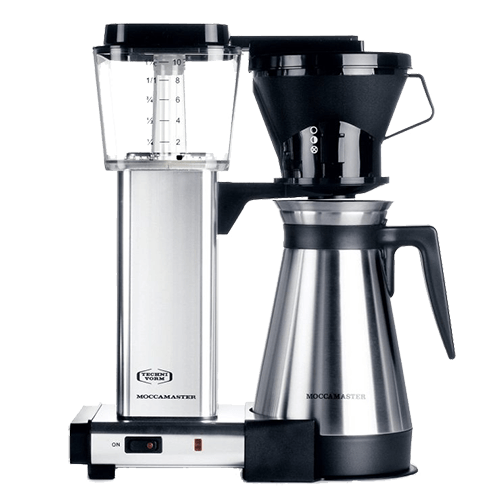
The KBT suits a household that wants a regular pot of filter coffee and is willing to get the dose and grind right. A copper element heats the water, which rises through the visible glass tube and pulses out through the nine-hole metal arm. Moccamaster specifies 196–205°F brewing water and a four- to six-minute full carafe. There is no temperature dial or recipe menu.
That makes the machine straightforward, but not indifferent to what goes into it. You control the amount of water, coffee dose, grind, and basket opening. The reservoir empties during each cycle; it is not a storage tank from which you select a serving later. For a useful starting batch, use 1 liter of water, 55 grams of medium-coarse coffee, a #4 paper filter, and the basket fully open.
A starting recipe for each batch size
These doses follow Moccamaster’s current US chart, based on approximately 55 grams per liter. They are a starting point for dialing in your coffee, not a promise that every bean will taste best at the same ratio. Use the reservoir’s liter and maker-cup marks; “10 cups” does not mean ten drinking mugs.
| Water | Cup mark | Coffee | Basket |
|---|---|---|---|
| 500 ml | 4 | 28 g | Half open |
| 750 ml | 6 | 41 g | Half open |
| 1 liter | 8 | 55 g | Open |
| 1.25 liters | 10 | 69 g | Open |
Without a scale: the same chart gives approximately 3, 4, 6, and 7 level scoops respectively, using the supplied Moccamaster 2-tablespoon scoop. These are approximate scoop counts, not exact gram equivalents; an ordinary eating spoon is not the same measure. Our brew ratio calculator helps with other measured batches.
Four maker cups is the manual’s recommended minimum for this size of brewer. The half-open basket helps a smaller batch drain more slowly, but it does not turn the KBT into a single-cup machine. If you usually want one small mug, that minimum is a more useful buying consideration than the maximum capacity.
The manual basket is the important detail
KBT and KBGT are easy names to confuse. The KBT has a manual-adjust drip-stop on its basket; you choose the opening yourself. The manufacturer specifies three positions:
- Open: seven maker cups through a full carafe.
- Half open: four to six maker cups, reducing flow through the outlet.
- Closed: prevents drips when taking out the basket after brewing.
Closed is not a pause-and-pour setting. Closing the outlet while hot water continues arriving can overflow the basket. Leave it in the correct brewing position until the cycle finishes. The original KBT also has a white carafe safety button in its base, but that interlock does not close the manual basket when you remove the carafe. The KBGT’s automatic basket is a different system.
Which thermal carafe are you buying?
The original 79112 pictured here has a tapered, stainless-lined thermal carafe with a round rim. The current KBT comes with a different glass-lined stainless-steel carafe, also compatible with older 40-ounce KBT brewers. A used machine may therefore have either version. Check the actual photos and liner description rather than relying on “stainless steel thermal carafe.”
For the original steel-lined carafe, a hot-water rinse before brewing limits heat lost to a cold vessel; empty that water before making coffee. Follow the newer carafe’s warm-rinse instructions if yours has a glass liner. Avoid sudden extreme temperature changes, ice cubes, and metal stirring utensils in that version.
The two lids do different jobs. The Brew-Thru lid receives coffee during brewing and lets you pour without removing it. Its mixing tube blends the incoming coffee, so stirring inside the carafe is unnecessary. The travel lid closes more fully for longer holding. The KBT quick guide suggests switching lids when keeping coffee for more than an hour.
To pour with the travel lid, Moccamaster says to loosen it roughly a quarter to half a turn, then tighten it again. Keep the carafe upright during transport. There is no warming plate: this pot retains heat, but cannot reheat coffee that has cooled.
A closer look
Details worth noticing.
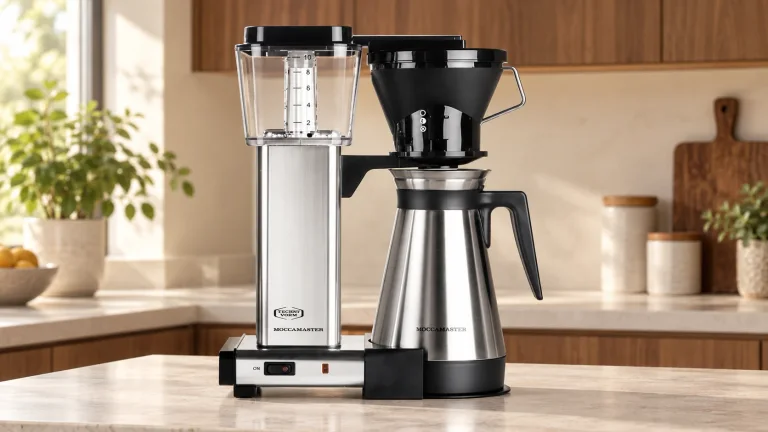
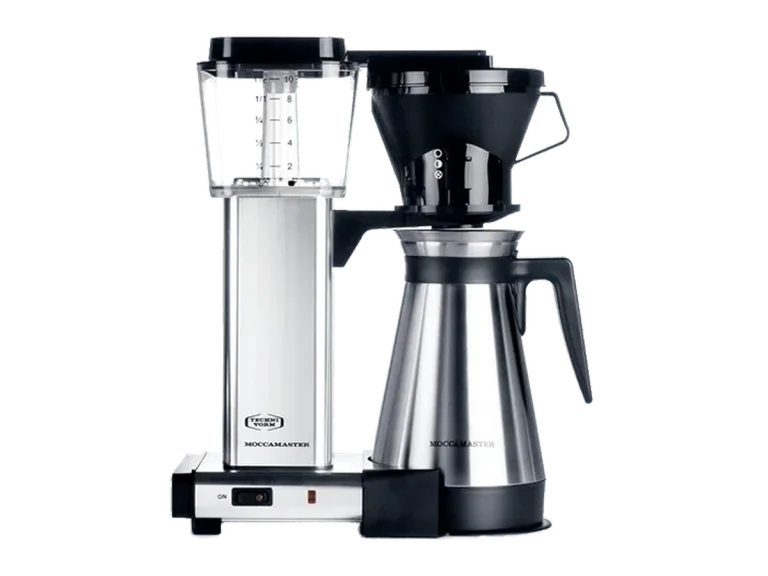
Product detail views: Archived product photograph
A repeatable morning routine
Before making the first coffee, the US manual calls for two water-only cycles. For everyday brewing, the useful preparation happens before you press the switch:
- Fill with a clean jug. Add the measured fresh, cold water. A separate jug keeps coffee oils from a used carafe out of the reservoir.
- Prepare the carafe. Rinse as appropriate for its liner, empty it, screw in the Brew-Thru lid, and seat it properly. On the original brewer, it must press against the white safety button.
- Fit one #4 paper filter. Rinse it and discard the rinse water. The maker recommends rinsing partly because it helps the paper sit against the basket walls and stay open. Add the coffee dose from the table.
- Check the basket position and lids. Choose half open or open for your batch. Fit the basket and reservoir lids, then switch on.
- Let the brew finish before serving. Keep the basket lid and carafe in place. Do not touch the hot metal outlet arm while brewing.
There is no need to lift the lid and stir the bed to force a bloom. Moccamaster’s pulsing water delivery handles that stage without intervention. The size of the bloom changes with the coffee; a small bloom alone does not prove the beans are stale.
On the original KBT, the heater stops when the reservoir empties, although the switch light may stay on. Switch the brewer off after use. Do not mistake that illuminated light for continued heating, or assume a later model’s switch timer applies to this older machine.
Get the water and grind right
Use fresh cold tap, filtered, or bottled water. Moccamaster advises against distilled or reverse-osmosis water because its very low mineral content can affect the copper heating element. Hard water brings a different problem: faster scale buildup and a greater need for descaling. Do not fill the tank with hot water to try to raise brew temperature.
Start with a medium-coarse grind, visually closer to coarse sand than fine powder. Moccamaster notes that many supermarket pregrounds are too fine for its preferred setup. A grinder matters because you can adjust the grounds when a particular coffee drains poorly or tastes thin, rather than being locked into a bag’s grind size.
Keep strength and extraction separate: dilute an otherwise balanced cup, and use the troubleshooting cases below when flavor or drainage is wrong.
Allow room for filling and loose parts
The tower and reservoir sit on the left, with the basket and carafe on the right. Check clearance above the brewer with room to lift the reservoir lid and pour, not merely enough height for the machine to stand beneath a cabinet. The reservoir is fixed; it does not lift out for filling at the sink.
Allow space to slide the carafe forward and set down a wet basket or lid. One switch makes the controls simple, but preparing a pot still involves several removable pieces. Confirm the seller’s dimensions for the exact version rather than assuming the newer carafe has the same footprint as the original.
Cleaning and descaling are separate jobs
After use, unplug the brewer and let it cool. Discard the grounds, hand-wash the basket and carafe with mild detergent, and rinse thoroughly. Wipe the machine with a damp cloth; do not immerse it. Keep the thermal carafe and plastic components out of the dishwasher.
Coffee oils: clean
Brown coffee residue needs a compatible coffee-equipment cleaner. Moccamaster lists BioCaf Cleaner and Cleancaf among its recommendations. Use the product’s directions for the part being cleaned.
Mineral deposits: descale
The US manual calls for descaling every 100 brews or at least every three months, with hard water potentially requiring more frequent treatment. Approved options include BioCaf Descaler and Dezcal. Follow the label dilution, then run two full reservoirs of plain water through the brewer.
The current maintenance guidance advises against vinegar. A coffee-oil cleaner is not automatically a descaler, and a homemade acid mixture is unnecessary when the maker specifies formulated products. A cloudy glass riser is a useful warning of mineral buildup; persistent cloudiness after proper treatment warrants a support enquiry.
Troubleshooting: the next useful adjustment
Start with the symptom you can observe. A slow-draining coffee bed and water that never reaches the outlet arm need different responses.
Thin, weak coffee
First match the dose and basket opening to the batch table. If both are right and the grounds look coarse, brew the next batch with a slightly finer grind. Look for fuller flavor without sluggish drainage or added harshness. This follows the maker’s weak-coffee diagnosis.
Bitter coffee with slow basket drainage
If the outlet is clean and correctly set but fine grounds hold up the water, try a slightly coarser grind at the same dose. Look for freer drainage and less harshness. If water delivery from the arm itself has slowed, investigate scale instead of repeatedly changing the grind.
A basket filling toward the rim
Switch off and let it drain and cool before handling. Check a closed lever first, then confirm one paper filter, the recommended dose, and a clear basket outlet. Do not put paper inside a mesh filter. The maker’s overflow checklist also flags overly fine grounds. If the correct setup still backs up, contact support before another trial.
The light is on, but no water moves
With water in the reservoir, check that the original carafe sits snugly against the white safety button. If correct seating starts the cycle, placement was the problem. If it does not, arrange manufacturer service; descaling is unlikely to fix a brewer that cannot move water through its heating system.
The older carafe loses heat quickly
Compare the next pot after preheating the stainless-lined carafe and using the proper lid. For longer holding, fit the travel lid. If coffee still cools unusually quickly, the original manual identifies damaged vacuum insulation as a possible cause. More descaler will not repair the carafe’s insulation.
The cup tastes good, but too strong
Add a small amount of hot water to the finished cup and taste again, as Moccamaster recommends. If you prefer the lower intensity, you have a useful serving adjustment without changing a brew that already tastes balanced.
Value, repairs, and buying an older KBT
The strongest reason to pay for a KBT is its combination of simple controls, a portable thermal pot, and continuing parts support. The official KBT parts range includes baskets, lids, outlet arms, carafes, feet, and a manual drip-stop repair kit. Replacing a worn external part is different from opening the electrical base; internal faults belong with manufacturer service.
A new brewer has a five-year limited warranty; a manufacturer-refurbished one has one year. Carafes and replaceable parts are excluded, and proof of purchase matters. Keep the receipt and model/serial details. Do not price a used machine as though it automatically carries a fresh five-year warranty.
For a used KBT, inspect the reservoir, basket lever, outlet arm, feet, and both carafe lids. Confirm that the carafe seats correctly and that its liner is the version you want. A 2026 thrifted-KBT account illustrates the catch: the brewer passed a water-only check, but the buyer then discovered missing lids and a foot. Include the cost of missing parts in your comparison.
If you want adjustable profiles, read our Fellow Aiden review. For broader choices, start with the coffee maker buying guide. The KBT’s premium makes more sense when its batch size and manual workflow suit you than when you need it to imitate a programmable or single-cup brewer.
Common questions
How much coffee does a full pot actually make?
The reservoir holds a nominal 1.25 liters, marketed as 10 maker cups or 40 ounces. Those labels are not ten mugs. Finished coffee is less than the water you add because the grounds retain some; choose your batch using the liter marks rather than assuming a measured finished yield.
Can I use a reusable metal filter?
The specified setup is a #4 cone paper filter. Mesh filters can change drainage and require careful cleaning; Moccamaster favors paper. Never combine paper and mesh to “filter better,” because the added restriction can cause overflow.
Will it work at high altitude?
Yes, although water boils at a lower temperature as elevation rises. If coffee is weak at high altitude, Moccamaster suggests slightly finer grinding or a small dose increase. Try one adjustment and compare the result, while watching for restricted basket flow.
Can the glass-lined carafe replace the old steel-lined one?
The current 40-ounce glass-lined replacement is listed for KBT, KBGT, and CDGT machines. Check the exact part before ordering, and use its own care instructions: the liner introduces precautions that did not apply to the original steel interior.