
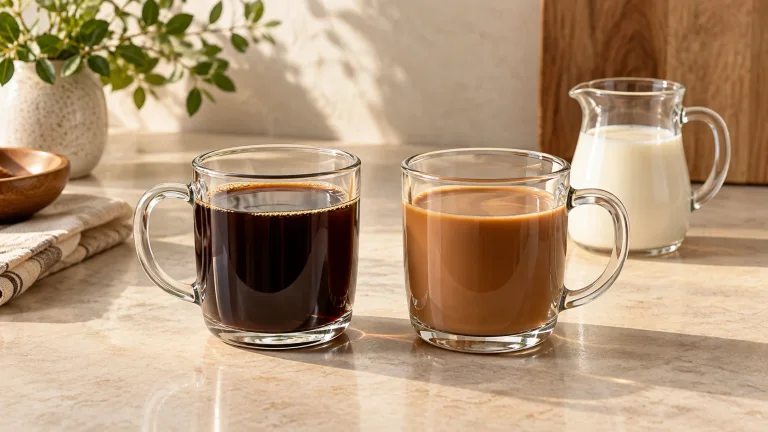
Adding milk changes coffee's flavor, texture and nutrition; it does not remove the caffeine already in the cup. The amount matters. In the actual US labels compared below, 30 mL of milk or a plant alternative adds about 4–19 calories. Those figures describe a small addition, not a latte or a universal value for every brand.
Choose the drink you enjoy. For a useful comparison, keep the brewed coffee the same, measure the milk, and count sweeteners separately. Here is what that looks like in an ordinary home routine.
Start with the same coffee
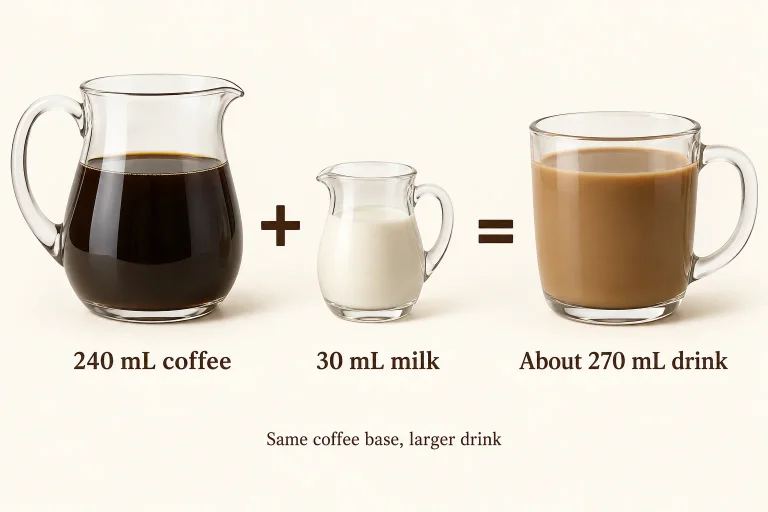
Our comparison begins with 240 mL of plain brewed coffee. The black version gets nothing added. The milk version gets 30 mL of milk, making about 270 mL of drink. Use a mug with room for the addition.
We deliberately use 240 mL to keep the examples simple. An actual US measuring cup is about 237 mL; nutrition labels often describe a cup as 240 mL. The difference is small; use the label's stated volume in the calculations below. NIST's household measures put a US tablespoon at approximately 15 mL.
Filling a fixed-size mug is a different comparison. If you replace 30 mL of a 240 mL coffee serving with milk, you keep only 210 mL of that coffee. Assuming it is evenly mixed, that is 87.5% of the original coffee and approximately 87.5% of its caffeine. The reduction comes from using less coffee.
What 30 mL of milk adds
Each row uses the same 240 mL coffee base. These are additional nutrients from the milk only, calculated from the exact makers' US labels checked on October 7, 2026. Black coffee's own nutrients are excluded from every row, so the zero-addition row does not mean coffee itself has no calories.
| Milk added to the same coffee | Calories | Protein | Saturated fat | Total sugars |
|---|---|---|---|---|
| None: black coffee | 0 added | 0 g added | 0 g added | 0 g added |
| Organic Valley Whole Milk, half gallon | 19 | 1.0 g | 0.6 g | 1.4 g |
| Organic Valley 2% Reduced Fat Milk, half gallon | 16 | 1.0 g | 0.4 g | 1.4 g |
| Silk Organic Unsweet Soymilk | 10 | 1.0 g | 0.1 g | 0.1 g |
| Silk Unsweet Almondmilk | 4 | 0.1 g | 0.0 g | 0.0 g |
| Oatly Original Oatmilk, US 32 fl oz carton | 15 | 0.4 g | 0.1 g | 0.9 g |
For reproducibility, those labels declare, respectively, 150, 130, 80, 30 and 120 calories per 240 mL. Their protein values are 8, 8, 8, 1 and 3 g. Divide each by eight for a 30 mL addition. Calories above are rounded to whole numbers and grams to one decimal; the original label values are already rounded.
These are examples, not a brand ranking. Other package sizes, sweetened versions, barista formulas and markets can have different labels. Check your own carton before using the numbers. In particular, a product described simply as “oat milk” is not automatically the Oatly Original formula shown here.
Calculate your own pour
The FDA's serving-size guide explains that nutrition figures usually refer to one labeled serving. Scale that serving to the amount you use:
Added nutrient = label value × milk added ÷ label serving volume.
Using the whole-milk example, 150 calories × 30 mL ÷ 240 mL gives 18.75, or about 19 calories. The same calculation works for protein, saturated fat or calcium when you keep the units consistent.
- 30 mL: one eighth of the label serving; about 19 calories and 1 g protein.
- 60 mL: one quarter; about 38 calories and 2 g protein.
- 180 mL: three quarters; about 113 calories and 6 g protein.
That is why a splash and a milk-heavy drink deserve separate entries in a food log. If you add 60 mL to each of three coffees, your total is 180 mL. Calculate from the unrounded label fraction first; adding rounded results can create a small discrepancy.
Add sugar, syrup, cream or flavored creamer as separate ingredients using their own portions and labels. They are not covered by the plain-milk calculation. For espresso drinks, our latte guide explains the different drink structure.
Does milk make coffee less caffeinated?
If you drink all the original coffee plus the milk, you still drink the caffeine from that coffee. Adding milk dilutes it into a larger volume. A lighter color or gentler flavor does not show how much caffeine you consumed.
For example, suppose a particular 240 mL coffee contains 100 mg of caffeine. Adding 30 mL of plain milk leaves about 100 mg in the full 270 mL drink. Keeping only 210 mL of the original coffee and replacing the rest with milk gives about 87.5 mg. The 100 mg starting value is illustrative, not a measurement or a claim about every mug.
For a latte, start with the espresso-shot count. To reduce caffeine, use less caffeinated coffee or substitute decaf; extra milk alone is not a caffeine-reduction method. Our caffeine serving guide covers actual reference ranges, and the caffeine calculator helps organize estimates. Neither establishes a personal safe dose.
Choose milk by the label and your preferences
Start with any dietary or allergy requirements, then compare products at the same volume. The FDA's guide to milk alternatives highlights differences in protein, fortification, saturated fat and added sugars. A plant-based name alone does not tell you those values.
Our 30 mL examples illustrate the portion effect: the dairy and soy options contribute about 1 g protein, while the almond and oat examples contribute less. A small pour provides only a fraction of a full serving's nutrients. If you use much more milk through the day, compare the full label, including calcium and vitamin D, rather than choosing solely by coffee calories.
Read total sugars and added sugars separately. Naturally occurring milk sugar appears under total sugars; added sugars are already included in that total. Do not add the two lines together. The FDA explains this label distinction.
The Oatly Original example lists 7 g total sugars, including 7 g added sugars, per 240 mL. Its maker explains that sugars produced during oat processing account for that declaration. That is about 0.9 g in our 30 mL portion. It is not the same product as an unsweetened oat drink.
Troubleshoot a cup that tastes too milky
Taste the black base before deciding which adjustment to make. Keep the coffee and other additions steady during a comparison so you can tell what the milk change does.
- The black coffee tastes good, but milk hides it: use one US measuring teaspoon less milk in the next comparable cup, about 5 mL. Look for clearer coffee flavor while retaining a texture you enjoy. This adapts Breville's measured, teaspoon-by-teaspoon reduction; you do not need to continue toward drinking it black.
- The coffee tastes weak before milk: more milk will not restore coffee strength. For the next brew, increase coffee relative to brewing water using your brewer's recipe and capacity limits, then compare the black result before adding your usual milk. AeroPress identifies this ratio adjustment as one way to strengthen a weak brew; it does not prescribe a universal dose increment.
- A new carton makes the drink sweeter than expected: check whether you switched from unsweetened to original, vanilla or another formula. Compare the next cup with the same measured portion of an unsweetened version suitable for your diet. Notice whether the extra sweetness decreases.
For milk choice itself, compare two equal portions of the same brewed batch with equal measured additions of different milks. Note which flavor and texture you prefer. This is a suggested home comparison, not a taste test conducted by Coffee Corner.
Lactose, allergy and reflux are different questions
NIDDK distinguishes lactose intolerance from milk allergy. Lactose intolerance concerns digestion of milk sugar, and the amount tolerated varies. Milk allergy involves the immune system. Lactose-free cow's milk still contains milk proteins, so it is not a workaround for a milk allergy. Check ingredients and allergen information rather than testing a known allergen in your coffee.
Milk also is not a treatment for acid reflux. Coffee, caffeine and high-fat foods can trigger symptoms in some people. NIDDK recommends discussing individual food and drink triggers with a clinician. A smoother taste does not prove that a drink prevents symptoms.
This is general food information, not an individualized dietary or medical recommendation. See our safety and information limits for the scope of Coffee Corner's guidance.
Frequently asked questions
How can I measure the milk without a scale?
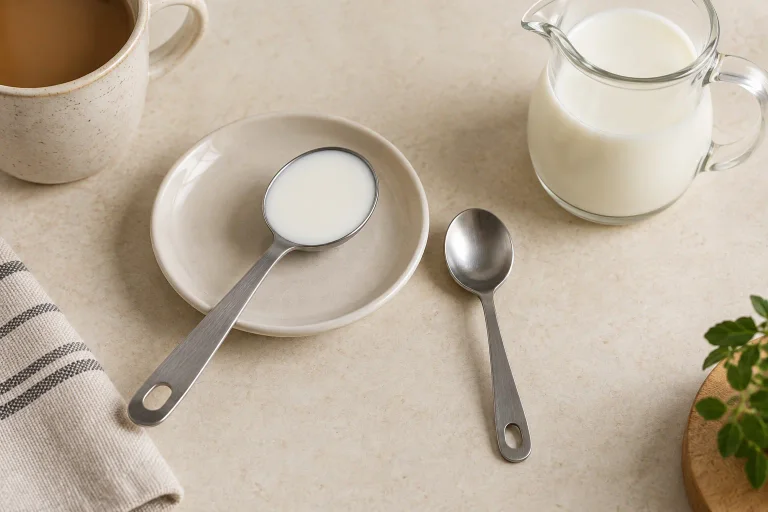
Use two level US measuring tablespoons for approximately 30 mL, or six level US measuring teaspoons. A marked 30 mL measure is another option. Ordinary eating spoons and mug sizes vary, so an unmeasured “splash” cannot give a dependable nutrition calculation. No weighing is needed for this volume-based method.
Is black coffee automatically the healthier choice?
It avoids the nutrients and calories of additions, but that alone does not establish the best drink for your needs. Compare the portion, ingredients, caffeine and relevant dietary requirements. Taste preference is a valid reason to add milk; neither choice needs to be a health contest.
Does milk cancel coffee's antioxidants?
A small 2010 crossover study in nine healthy adults found that adding 10% whole milk to instant coffee did not significantly alter the measured overall appearance of coffee phenolic acids in blood. The authors were affiliated with Nestlé's research center. This was short-term absorption research, not evidence of disease prevention or a verdict on every milk-and-coffee recipe. Our coffee benefits and downsides guide covers broader health context.
Can I use this table for a café latte?
Only if you know the exact milk and amount used. The table describes a 30 mL addition to brewed coffee. For a café drink, use the shop's nutrition information for the actual size and customization when available; count caffeine from the coffee or espresso separately.
How this comparison was researched
We checked US maker labels, FDA and NIDDK guidance, NIST measures and the cited research abstract on October 7, 2026. Nutrition figures are calculations from rounded labels, not laboratory measurements. Coffee Corner has not physically tested these drinks. Images are AI illustrations. The named products supply transparent examples; they are not shopping recommendations.