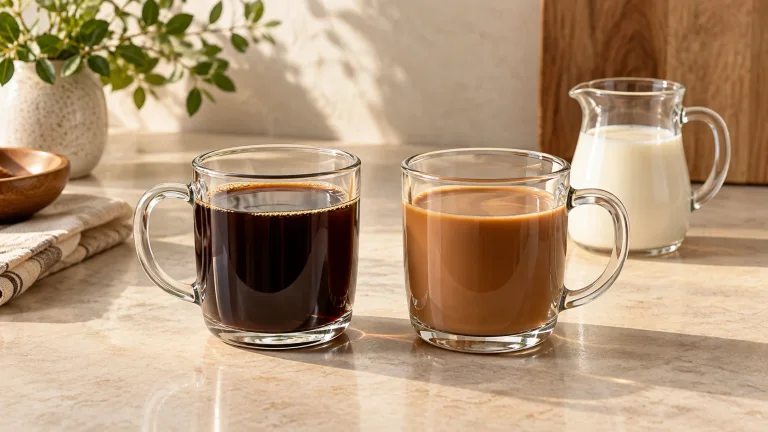

Choose a latte for a larger milk drink, a cappuccino for more foam, a cortado for a smaller coffee-and-milk serving, or an Americano for espresso diluted with water. An espresso macchiato has only a small addition of milk; a latte macchiato is a much larger milk-first drink.
Ready to make one at home? Try a small cortado with equal parts espresso and milk, spoon cold foam onto iced coffee, or pour espresso over ice cream for a simple affogato.
For three more styles, compare café au lait made with brewed coffee, breve coffee with half-and-half, and dalgona coffee topped with whipped instant coffee.
For a sweet, concentrated coffee, try Cuban cafecito with whipped sugar foam. For a longer spiced drink, dirty chai combines chai, milk and espresso.
Start with three questions: what coffee base is used, how much milk or water is added, and how much foam do you want? The examples below come from named makers and roasters. They explain the menu without pretending every café uses the same recipe.
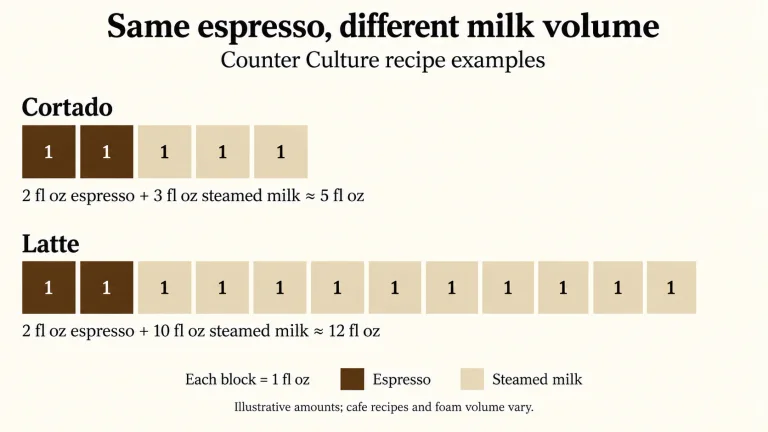
Coffee drink proportions and serving-size examples
These Counter Culture examples use approximate US fluid ounces. Milk means the steamed amount poured, not cold pitcher fill.
| Drink | Espresso | Addition | Approximate total |
|---|---|---|---|
| Espresso | 2 | None | 2 |
| Americano | 2 | 8 water | 10 |
| Cortado | 2 | 3 milk | 5 |
| Cappuccino | 2 | 6 milk | 8 |
| Flat white | 2 | 6 milk; less foam | 8 |
| Latte | 2 | 10 milk | 12 |
Leave headroom in the cup. These calculated totals are not measured yields.
Espresso: the base, without milk
Espresso is concentrated coffee brewed under pressure through fine grounds. For a scale-based starting recipe, Breville gives 19 g dry coffee and 38 g finished espresso, with a 20–30-second extraction window. That is a 1:2 ratio by mass. It is a separate example from the chart's approximate fluid-ounce serving.
- Heat the machine as directed. Dry the basket and use a dose within its specified capacity; 19 g will not fit every basket.
- Distribute the grounds and tamp level. Lock the portafilter in place.
- Set a cup on the scale, zero it and stop brewing at the target beverage weight. Keep hands clear of the hot spouts.
- Taste before adding milk. Record the dose, yield and time so you can compare the next shot.
Yield means coffee collected in the cup, not tank water. Crema makes volume an unreliable substitute for grams. A ristretto uses a smaller yield from a similar coffee dose; a lungo passes more water through the grounds. Adding water afterward makes a different drink.
Americano: espresso and hot water
Combine espresso with hot water in a heat-safe mug. The chart offers one proportion; Starbucks' UK home recipe instead uses two shots and 250 mL water. Choose one recipe and leave room to stir.
A long black also combines these ingredients. Breville pours espresso over water, but Starbucks does that for its Americano too. Pouring order alone does not reliably identify the drink. Ask about water quantity and shots; an Americano is not drip coffee.
Latte: more milk with a smooth texture
A latte combines espresso with steamed milk and a modest foam cap. Breville's latte method aims for fine, integrated milk. Swirl just before pouring so liquid and foam move together.
Milk expands as air enters: steam only a quantity your pitcher and machine can handle. Respect fill limits, keep clear of hot steam, and turn steam off before withdrawing the wand. See the latte guide for preparation and variations.
Cappuccino: pay attention to the foam
A cappuccino is a foamy espresso-and-milk drink. In Breville's preparation, the final pour leaves a thicker foam cap than its latte. Milk and foam should still pour together; a diagram of three separate equal layers is not a universal recipe.
To reproduce a café drink, ask its cup size and shot count before copying an internet ratio. A small cappuccino and a large chain cappuccino can share a name while using different amounts. Our cappuccino guide covers steaming technique and assembly.
Flat white and cortado: similar ingredients, different examples
A flat white emphasizes espresso with finely textured milk and relatively little foam. Breville's version keeps the surface foam thin. Do not assume that the name guarantees a particular shot count or a ristretto base.
A cortado is a compact espresso-and-milk drink. The chart is one roaster's example; Peet's 2024 menu introduction describes equal espresso and steamed milk. That difference is a reason to ask how a shop makes it, not to declare one of the drinks mislabeled.
Espresso macchiato: a small mark of milk
Start with espresso and add a little textured milk or foam. Breville's example adds two teaspoons of textured milk; use standard measuring teaspoons. It steams more milk than this to make the texture; the entire pitcher does not go into the drink.
The coffee remains the main part of the serving. Order an espresso macchiato if that small drink is what you want.
Latte macchiato and caramel macchiato
For a latte macchiato, pour frothed milk first, then add espresso. Starbucks' example starts with 175 mL cold milk and one espresso shot. Warm and froth the milk, pour it into a heat-safe glass with space for both foam and coffee, then add the espresso slowly through the middle. The finished size depends on the foam; 175 mL is not a promised final yield.
A commercial caramel macchiato can be a sweet milk drink: Starbucks' iced recipe includes vanilla syrup and caramel sauce. The name does not mean a tiny espresso macchiato with caramel added.

Mocha: espresso, chocolate and milk
For a simple mocha, Breville adds two teaspoons of drinking chocolate to espresso, stirs, then pours in textured milk. Drinking chocolate is not automatically interchangeable with unsweetened cocoa or syrup; check what you are using.
Mix the chocolate into the coffee before adding the milk so it disperses. Decide whether you want a sweeter drink before adding whipped cream or extra sauce. The chocolate is the defining addition; toppings are optional.
Iced latte: cold milk needs no steaming
For an unsweetened adaptation of Starbucks' iced latte, use 30 mL espresso, 175 mL cold milk and ice. Omit the recipe's vanilla syrup. Put ice into a glass suitable for temperature changes, add the espresso and pour in the milk. Stir gently.
The liquids total 205 mL before ice. Use a larger glass and leave headroom; the amount of ice and subsequent melting change the serving volume. This recipe uses cold milk, not steamed milk cooled afterward.
Iced coffee and cold brew are different methods
Iced coffee begins as hot-brewed coffee, then is chilled or brewed over ice. Cold brew steeps grounds in cool water for hours. Either may be served black or with milk. Neither automatically means an iced latte, whose base is espresso.
Cold brew may be concentrate or ready to drink. Use the dilution specified by its recipe rather than assuming every batch needs equal water. Our cold-brew and iced pour-over guide gives separate, complete methods.
Ask for the change you actually want
- More coffee flavor: ask for a smaller milk drink or less milk with the same espresso.
- Different texture: say whether you want little foam or a thicker foam cap.
- Less sweetness: ask for less syrup or no syrup, and check chocolate or caramel additions.
- Less caffeine: ask about decaf and shot count. Milk and water dilute the coffee but do not remove its caffeine. See our caffeine guide and estimate limits.
For an unfamiliar café, “What size is your flat white, and how many shots?” is more useful than expecting its menu to match another shop's.
Troubleshooting: make the next comparison specific
Keep the coffee base steady while comparing these changes.
- The milk pours as a foam blob: if bubbles separate from liquid, follow Breville's latte advice: gently tap out larger bubbles and swirl immediately before pouring. Look for a uniform, glossy flow.
- A milk drink hides otherwise pleasant espresso: taste the espresso before mixing. If the base is satisfactory, try a smaller milk portion with the same shot. Compare how clearly you can taste the coffee.
- The iced latte is weak from the first sip: if you added more milk than the recipe's 175 mL, return to that amount with the same 30 mL espresso. Check whether coffee is more noticeable immediately.
- Your “macchiato” is a large sweet drink: check whether it contains vanilla and caramel. Next time specify espresso macchiato with a small milk addition and no syrup; confirm the size before ordering and check that the serving matches.
Frequently asked questions
What can I make without an espresso machine or scale?
Make a café au lait from finished brewed coffee and warm milk. Starbucks uses 230 mL brewed coffee with 115 mL milk. An approximate cup adaptation is one US measuring cup of brewed coffee plus half a US measuring cup of milk; a US cup here is 8 fl oz. This is the same 2:1 volume ratio, not a conversion from coffee grounds.
Brew coffee with your usual method. Warm the milk gently in a saucepan without boiling, then combine in a heat-safe mug larger than 12 fl oz. Frothing is optional in this simplified adaptation. It makes coffee with milk, not espresso. Choose a base method in six home brewing methods and follow the preparation safety guidance.
Does a larger drink always contain more espresso?
No. A café may enlarge a drink by adding milk or water, by adding shots, or both. Ask about the recipe. Cup size and a dark appearance cannot establish caffeine content.
Can plant-based milk use the same recipe?
You can substitute a suitable milk alternative, but its foaming behavior may differ. Start with the maker's temperature and fill instructions, then compare texture before changing the coffee. The amount in the pitcher and the amount finally poured are different measurements.
Research note
Updated October 11, 2026 from manufacturer and roaster references. We preserved the corrected definitions, added source-specific serving comparisons, flat white and cortado, a usable no-machine alternative and diagnostic troubleshooting. Coffee Corner has not prepared, tasted or measured these drinks. The images are AI illustrations; calculated totals are not observed yields. Café recipes vary, and the historical Peet's example documents that variation rather than current availability.