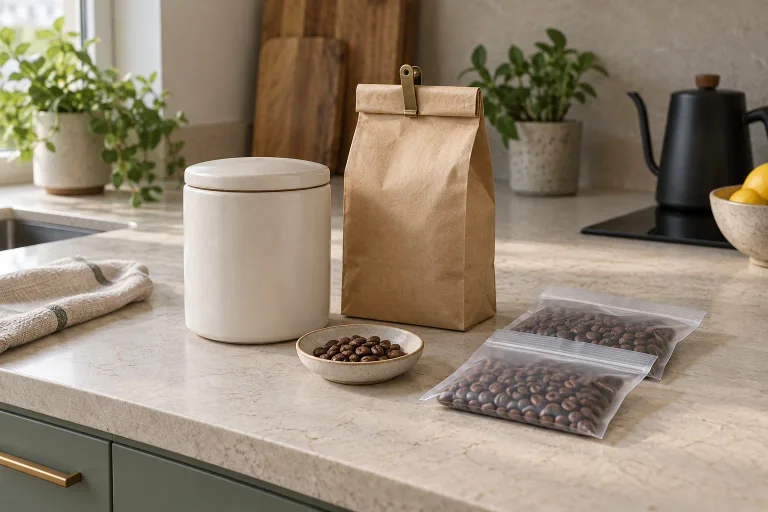
Keep daily-use coffee in a tightly sealed bag or airtight container in a cool, dry, dark cupboard. Grind only what you need. For spare coffee you will not finish soon, freeze sealed portions and choose a thawing routine that keeps moisture away from the beans.
You do not need an expensive canister to start. A sound seal, a sensible storage spot and a bag size that fits your routine matter more than the appearance of the container. The useful question is how to keep this bag enjoyable until you finish it.
Once you have a suitable storage spot, arrange the rest of your home coffee corner around dry supplies, a clear brewing area and an easy cleanup route.
What happens to coffee after roasting?
Roasted coffee changes as it releases gas and loses aroma. The Specialty Coffee Association's explanation of freshness describes both degassing and oxidation, including the faster changes after grinding. Storage slows these changes; it cannot make an old bag fresh again.
Freshly roasted does not always mean ready to brew that minute. Follow the roaster's advice for the particular coffee. For example, Tim Wendelboe describes approximately 5–10 days of rest for its coffees. That is its own guidance, not a universal countdown for every roast and brew method.
Keep the roast date, opening date and any storage changes with the bag. These dates answer different questions. A sealed bag stored carefully is not directly comparable with the same coffee after weeks in an open grinder hopper.
Choose a storage method for how you drink
| Situation | Practical approach | Main thing to avoid |
|---|---|---|
| One bag in regular use | Resealable barrier bag or airtight container in a cupboard | A loose closure beside a warm appliance |
| A clear glass jar you already own | Use a sound seal and keep the jar inside a dark cupboard | Leaving it in sunlight as a display jar |
| Several unopened bags | Plan the order you will use them; consider freezing the surplus | Opening every bag without a plan to finish it |
| Occasional brewing or several small samples | Clearly labeled, airtight freezer portions | Opening and returning one large cold supply each day |
| Pre-ground coffee | Buy a manageable bag and reseal promptly after measuring | Grinding a large batch in advance unnecessarily |
Baratza supports a sealed barrier bag or an airtight container, with clear jars kept in a dark cupboard. Check the closure you actually have: a folded paper top is not equivalent to a properly closed zip seal.
Use the container properly
Choose a clean, dry, food-safe container with an undamaged lid and seal. After washing it according to its instructions, let all parts dry completely before filling. Keep the bag label or write the coffee name, roast date and opening date on the container.
With a resealable bag, remove loose grounds from the closure and press along the full seal. If the closure tears, transfer the coffee rather than repeatedly rolling a damaged top and hoping it stays shut. Keep the scoop dry; measure away from kettle steam and close the container before brewing.
A vacuum canister adds a sealing step, so follow its own instructions, including how to confirm the seal and care for its mechanism. Do not assume that a canister is freezer-safe or dishwasher-safe because another model is. A more complicated lid only helps if it is convenient enough that you use it properly.
Use up the previous coffee before adding another bag. Continually topping up mixes ages and makes it harder to work out which coffee produced a flavor change. If a little remains, label it separately for the next brew rather than letting old beans live indefinitely at the bottom.
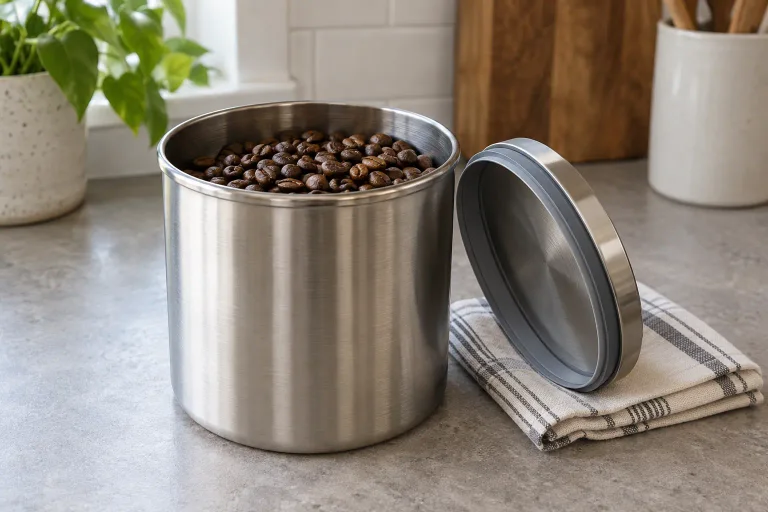
Find a cool cupboard, not just an attractive shelf
The National Coffee Association identifies air, moisture, heat and light as the main storage problems. A cupboard near the oven or dishwasher can become warm even though it looks suitably dark. Check the location during cooking, when appliances are actually running.
Keep beans away from the espresso machine's cup warmer, a sunny window and steam from a kettle. In a small kitchen, a shelf on the opposite side of the room may be more useful than a special container sitting in the hottest part of the counter.
Refrigerating the daily bag adds repeated moves between cold storage and warm air. Baratza advises against this routine because of condensation. A cupboard is simpler for coffee you are using regularly; the freezer is a separate option for sealed reserves.
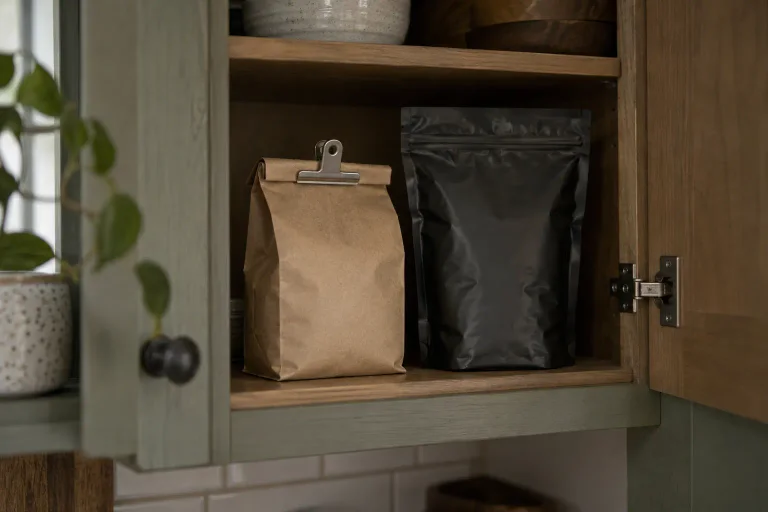
Calculate how quickly you finish a bag
Start with your actual dry-coffee dose, not the number of “cups” advertised on a brewer. Divide the bag's weight by the amount you use in a day. This is a shopping calculation, not an expiration date.
| Daily dry-coffee use | Calculation | Approximate duration |
|---|---|---|
| 18 g | 340 ÷ 18 | 19 days |
| 30 g | 340 ÷ 30 | 11 days |
| 60 g | 340 ÷ 60 | 6 days |
Allow for dialing in and occasional extra drinks. If you brew only on weekends, count brewing days separately: the 19-dose bag can remain open for many calendar weeks. That is when a smaller bag or portions for the freezer becomes useful.
For two people sharing one 30 g French press batch daily, a 340 g bag provides eleven complete batches with 10 g left. For two separate 30 g batches each day, it provides five full days plus one extra batch. Serving count and coffee dose are not interchangeable.
The NCA suggests buying roughly one or two weeks' supply as a practical freshness habit. Use your calculation to choose a bag or delivery interval, then adjust based on how that coffee tastes toward the end. It is not a reason to discard sound coffee on a fixed day.
Whole beans, pre-ground coffee and grinder hoppers
Grind shortly before brewing when your setup allows it. For pre-ground coffee, buy the grind intended for your method and protect the opened bag just as carefully. Pre-ground coffee can be the sensible choice when convenience or accessibility makes home grinding impractical.
A grinder hopper is convenient during use, but do not automatically empty a large bag into it. Follow your grinder's operating requirements and keep the reserve sealed separately. If you change coffees often, label the hopper contents so you do not mistake yesterday's beans for the new bag.
For a machine that expects beans in a hopper, use an amount that fits your routine rather than changing to an unsupported single-dose workflow. Our whole-bean guide explains the control grinding provides; the grinder guide covers matching equipment to your brewing method.
How to freeze coffee beans
Freezing is useful for surplus coffee, especially when you want to keep several coffees without repeatedly opening them all. Decide how you will use each portion before freezing it. Do not wait until a bag tastes stale and expect the freezer to restore its aroma.
- Choose the portion size. Keep your current supply separate. Prepare either complete single-brew doses or a small bag you can use over a few days.
- Use suitable packaging. Put the coffee in clean, dry, food-safe, airtight freezer packaging. Follow the container maker's temperature limits. An unsealed retail bag is insufficient.
- Label it. Record the coffee, roast date if known, portion weight and freeze date. Keep the oldest portions easy to find.
- Freeze and leave sealed. Take out only the portion you intend to use. Choose one of the two workflows below.
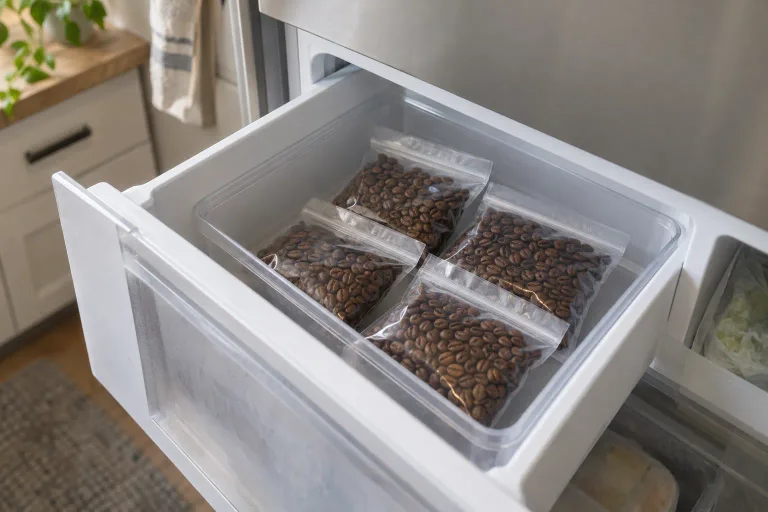
Option one: thaw the sealed portion
For a bag you will use over several days, Cravens Coffee recommends thawing overnight at room temperature while still sealed, then opening only after it has fully thawed. Keep that portion in your usual cupboard storage afterward. This avoids exposing cold beans to room air while they warm.
Put tomorrow's sealed portion out when you close the current bag in the evening. Do not use an oven, microwave or hot-water bath to speed it up. Leave the remaining portions in the freezer, and avoid cycling the opened daily supply back and forth.
Option two: use individual frozen doses
Baratza describes removing an individual portion immediately before grinding. Use this approach only when it fits your grinder's instructions. Open one dose and use all of it promptly; do not leave exposed cold beans sitting around or return the leftovers to the reserve.
The workflows are different. Thawing a sealed bag keeps room air away during warming; opening a frozen single dose for immediate use avoids keeping an opened cold supply. Pick the routine you can repeat, and keep water or condensation out of the grinder.
ONA Coffee also emphasizes small airtight portions and coffee-specific timing. Its filter and espresso guidance differs, so there is no need to treat one frozen-bean grind adjustment as universal. If brewing behavior changes, record the storage method and adjust one variable at a time.
How long does coffee stay fresh?
There is no single flavor deadline that covers every roast, package and storage routine. As a reference point, the NCA lists roughly one to three weeks for opened roasted beans at room temperature and three to four months frozen, under its stated storage assumptions. These are freshness estimates, not guarantees for your bag.
Compare those broad windows with the roaster's own advice. Square Mile recommends enjoying its beans within one month after opening and within three months of roasting. Different guidance can reflect different coffee and packaging, rather than a universal rule you must resolve into one exact day.
For a useful check, brew the same coffee with the same recipe near the start and end of a bag. Note whether the aroma is less distinct or the flavor less enjoyable. Our coffee tasting guide gives simple prompts. Taste alone cannot prove that storage caused a change; dirty equipment, grind and water are other possibilities.
Freshness and food safety are different questions. The NCA notes that moisture can allow mold to develop. Discard visibly moldy coffee or a supply contaminated by moisture, pests or other substances; do not taste it to decide whether it is usable. Follow any product-specific storage instructions.
Make the routine fit your week
- Daily brewer: keep one manageable bag in use and close it before starting the kettle.
- Weekend brewer: count doses rather than relying on a monthly subscription interval; smaller portions may be easier to finish.
- Several coffees open: label each clearly and plan which to finish first. Freeze the reserve before it becomes forgotten surplus.
- Occasional cold-brew maker: set aside the dry dose for a batch. Storage of brewed coffee is different; use the refrigeration guidance in our cold-brew guide.
Fix the most common storage mistakes
If the coffee suddenly tastes dull, check the seal, heat exposure and whether a wet scoop or steam reached the supply. Then clean the brewing equipment as directed before changing several recipe settings. Our troubleshooting guide helps separate storage from brewing issues.
If the same problem appears only at the end of each bag, reduce the next order or divide the surplus when it arrives. If it happens on the first cup from every bag, storage may not be the main issue. Check the water, recipe and equipment rather than buying another canister automatically.
Coffee storage questions
Can I leave coffee in its original bag?
Yes, if it is a protective bag that reseals securely. Keep it in a cool, dark cupboard and close the full seal. Transfer coffee if the closure is damaged or the bag cannot close properly.
Should I refrigerate coffee beans?
For the daily supply, a sealed container in a suitable cupboard is simpler. Repeatedly taking cold beans into warm air risks condensation. Use properly sealed freezer portions when you need longer storage.
Can I freeze a whole unopened bag?
You can use the sealed-bag approach if its packaging is truly airtight and suitable for freezing. Consider whether you can finish the bag comfortably after thawing. Smaller portions avoid repeatedly opening a large frozen supply.
Should I thaw beans before grinding?
For a multi-day portion, thaw it completely while sealed, then open it. Individual doses can be used immediately from frozen when your grinder's instructions allow. Do not leave exposed cold beans warming beside the grinder.
Will freezing make stale coffee fresh again?
No. It can slow further change, but it cannot put lost aroma back into the beans. Plan storage around coffee you already enjoy, and keep the portions dated so they do not become forgotten freezer stock.