Breve coffee is an espresso drink made with half-and-half instead of ordinary milk. It can be a small, rich cup or a larger café drink, served hot or over ice. For an easy home starting point, combine 60 mL espresso with 60 mL warm half-and-half—roughly 4 US fl oz before foam.
The carton makes the main difference. Half-and-half contains milk and cream, so it changes the richness without requiring a different espresso recipe. Start without syrup, taste the finished drink, then decide whether you want more dairy, less dairy or a little sweetness.
What does breve mean on a coffee menu?
In US coffee ordering, “breve” can describe the whole drink or tell the barista to use half-and-half. Breville's explanation gives an equal-parts espresso-and-half-and-half version and also describes “made breve” as a dairy substitution. Those are useful starting ideas, not a fixed recipe shared by every café.
The Human Bean's menu offers its espresso-and-half-and-half drink hot, iced or blended. Its serving sizes extend well beyond a small espresso cup. That is why asking for “a breve” without specifying size can produce something different from the compact drink you had in mind.
Decide on three things when ordering: the cup size, the espresso amount and whether you want flavor syrup. “A small hot espresso drink with half-and-half, no syrup” is a useful starting description. Then let the barista explain the shop's sizes and shot counts.
A small hot breve recipe
Yield: one drink, approximately 120 mL before any foam. Time: about 5 minutes with your coffee equipment ready; allow additional machine warm-up time if needed. This is a small equal-parts version, not a copy of a chain's large flavored drink.
Ingredients
- 60 mL freshly brewed espresso (about 2 US fl oz)
- 60 mL plain half-and-half (about ¼ US cup), plus extra only if your steaming equipment requires it
Method
- Prepare the cup. Use a heat-safe cup larger than 120 mL so there is room to pour without filling it to the rim.
- Brew the espresso. Prepare your usual espresso and portion approximately 60 mL for this drink. Do not extend an otherwise balanced extraction just to reach that volume.
- Warm the half-and-half. Gently heat the measured 60 mL in a small saucepan over low heat, stirring and stopping before it simmers. For steaming instead, check that your equipment permits half-and-half and follow its fill requirements.
- Combine and serve. Pour the warm half-and-half into the espresso and stir gently. Serve promptly; a little fine foam is welcome, but a stiff cap is unnecessary.
The equal volumes apply to the finished coffee and dairy, not dry grounds and brewing water. Keep the espresso recipe that already works with your basket and beans. If your normal shot produces a smaller serving, use a similar amount of half-and-half instead of forcing more water through the coffee.
A measuring cup is helpful for learning the drink's proportions. It is less useful for judging espresso extraction because crema changes the apparent volume. If you normally brew espresso by weight, continue doing that; use the volumes here to guide how much dairy you add.
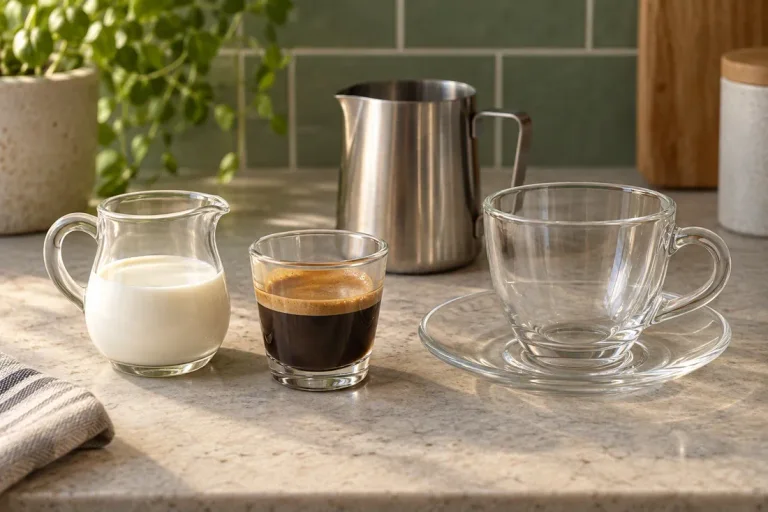
Choose the right half-and-half
Start with plain refrigerated half-and-half, then read the ingredient list. For example, Organic Valley's standard product lists milk and cream. You do not need vanilla flavoring or added sugar to make the basic drink.
| Carton | How to use it |
|---|---|
| Plain half-and-half | The straightforward choice for the recipe above; check the package's storage directions. |
| Heavy whipping cream | A different, richer ingredient. Do not assume a full-volume swap will give the same balance or texture. |
| Flavored coffee creamer | Check its ingredients and sweetness. It changes the recipe as well as the flavor. |
| Fat-free or reduced-fat half-and-half | A modified formulation. Use its own instructions and expect a different result from regular half-and-half. |
| Plant-based creamer | Can make a creamy alternative; confirm its ingredients and heating guidance rather than expecting dairy behavior. |
Land O'Lakes explains how its fat-free half-and-half differs from the traditional formulation. The similar name does not mean the cartons are interchangeable for every purpose. If you already like a particular alternative, try a small serving before filling a large steaming pitcher.
For a dairy allergy, ordinary half-and-half is unsuitable. A lactose-free dairy product still contains milk ingredients. Check the actual label and ask about shared equipment when ordering a milk alternative.
Warming and steaming without making a pitcher of foam
A breve does not need a tall foam mound. The saucepan method gives you direct control over a small portion, with no minimum frother fill to work around. Use low heat, stir, and pour when warm enough for your drink. Avoid simmering it or leaving the pan unattended.
If you prefer a steam wand, use half-and-half only where your machine's instructions allow it. Begin with a cold, clean pitcher and cold dairy. Introduce only a little air, then concentrate on mixing the texture rather than increasing the volume. Shut off the steam before taking the wand out, and clean it immediately as the manual directs.
The amount in the pitcher is not necessarily the amount in the cup. Some equipment needs more than 60 mL to cover the whisk or work safely. Follow that minimum, then pour only the portion you want. Making two drinks can be more sensible than heating a large batch for one small cup. Do not return warmed leftovers to the original carton.
An electric milk frother is not automatically suitable for cream mixtures. Check the permitted ingredients and the separate heating and frothing fill lines. If its instructions allow milk only, use the saucepan method. Our cappuccino guide explains milk texture, but it does not override an appliance's ingredient limits.
How to make an iced breve
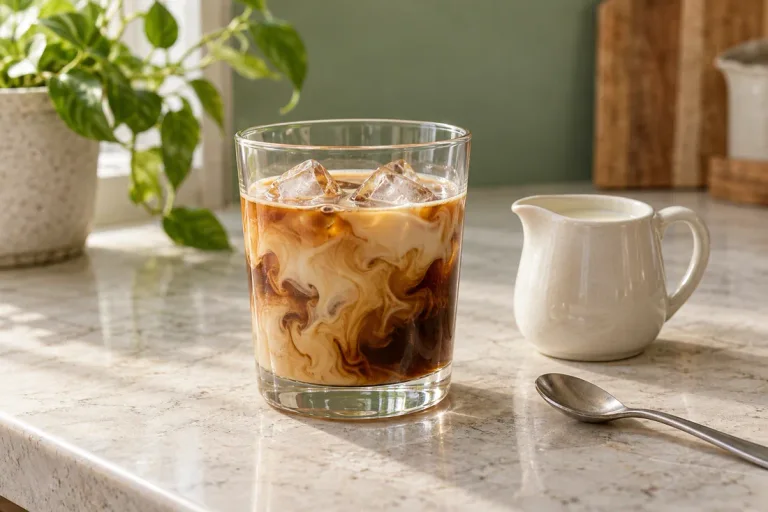
Use the same starting amounts—60 mL espresso and 60 mL cold half-and-half—but leave the dairy cold. Brew into a small heat-safe jug, stir in the half-and-half, then pour the mixture over ice. Choose a serving glass with enough room for 120 mL of liquid plus the ice; do not fill it to the rim first.
Stir and taste promptly. Melting ice changes the drink as it stands, so a large glass does not necessarily need more half-and-half. If the result tastes too diluted, first look at the ice, serving time and espresso concentration before adding extra cream.
For a flavored version, stir syrup into the espresso before adding cold dairy. Begin with a small amount and taste; the recipe does not need syrup to qualify as a breve. Dutch Bros' iced Kicker is one commercial example combining espresso, half-and-half and Irish cream flavor. Its name and recipe should not be taken as the definition of every breve.
Breve versus latte, cortado and café au lait
| Drink | Useful distinction | Choose it when |
|---|---|---|
| Breve | Espresso with half-and-half | You want a richer dairy component |
| Latte | Espresso with a larger portion of milk | You want a longer milk drink |
| Cortado | A compact espresso-and-milk drink, often near equal parts | You want a small milk serving without switching to cream |
| Cappuccino | Espresso with steamed milk and a more noticeable foam texture | You particularly enjoy the foam |
| Café au lait | Brewed coffee with warm milk | You want to use a regular coffee brewer |
For a small milk drink, follow the cortado recipe. If you have a pot of brewed coffee, the café au lait guide is a better match than trying to call that coffee espresso. You can still enjoy half-and-half in brewed coffee; just be clear about which base you are using.
Fix the balance before adding more ingredients
- Too rich or coating: reduce the half-and-half in the next serving. If you consistently prefer less richness, use ordinary milk and make a latte or cortado instead.
- The coffee disappears: measure what you pour. An unexpectedly large dairy portion can hide the balance you liked in the espresso.
- Large bubbles or a stiff cap: introduce less air next time. Swirl the warmed mixture gently; you are trying to make it pour smoothly, not whip cream.
- The drink arrives lukewarm: have the serving cup ready and coordinate the coffee and dairy. Avoid making one component and leaving it while you slowly prepare the other.
- Scorched, separated or unpleasant dairy: stop using it. Check the carton, storage and heating method rather than covering the problem with syrup.
Change one thing at a time. Keep the same coffee, change the dairy portion, and compare the result. If the espresso tastes unpleasant on its own, use our coffee troubleshooting guide before adjusting the whole drink around a poor shot.
Calories, caffeine and keeping the dairy cold
The most useful nutrition starting point is the amount of half-and-half actually used, not the cup's capacity. On October 13, 2026, Organic Valley's standard half-and-half label listed 40 calories per 30 mL. Using 60 mL of that product contributes about 80 calories from the dairy alone, before counting the espresso or any syrup. Use your own carton for the calculation; this is not a universal total for café breves.
Half-and-half does not add caffeine. The coffee's dose, beans and preparation matter, and an extra shot changes the drink regardless of its dairy. Our coffee caffeine guide and caffeine calculator can help put estimated servings in context. Do not infer a caffeine amount just from “small,” “double” or “breve.”
Keep the carton refrigerated and follow its opening and use-by instructions. The FDA advises a refrigerator temperature of 40°F (4°C) or below. Its room-temperature limit for perishable foods is two hours, or one hour when the temperature is above 90°F (32°C). Count preparation and serving time together, and make only the warm drink you intend to serve.
Breve coffee questions
Is breve the same as a latte?
Both can use espresso as their base. A breve uses half-and-half where a regular latte uses milk. Café sizes and proportions vary, so order the size and number of shots you want rather than relying on the name alone.
Is a breve always sweetened?
No. The basic recipe needs espresso and plain half-and-half. Syrups and sauces are optional, although a café may use them in a named breve drink. Ask for no added syrup if that is what you want.
Can I make an iced breve?
Yes. Mix the espresso with cold half-and-half in a heat-safe jug, then pour over ice in a glass with enough room for both liquids. Steaming the dairy first is unnecessary for this version.
Does breve have more caffeine than a latte?
Not because of the half-and-half. The espresso preparation and quantity determine the main caffeine contribution. If two drinks use the same coffee dose and extraction, changing the dairy does not add more caffeine.