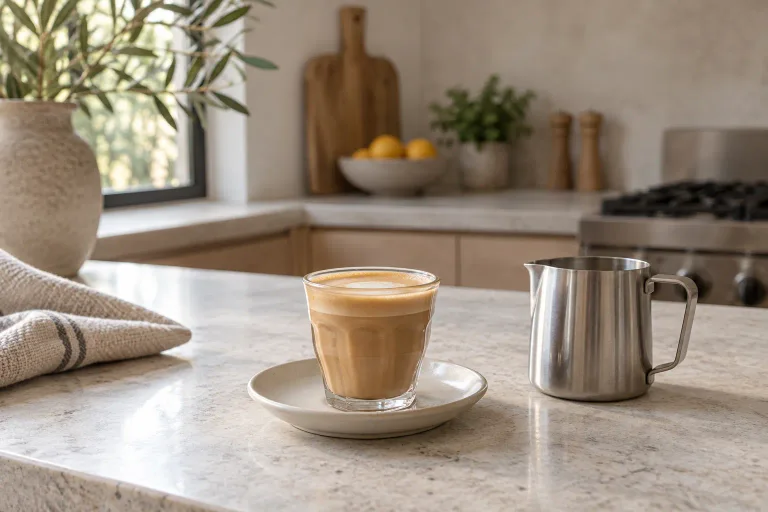
A cortado is espresso softened with a small amount of warm milk, often close to equal parts coffee and milk. It stays compact and coffee-forward, with a light milk texture rather than a tall cap of foam. The name comes from the Spanish verb cortar, meaning “to cut.”
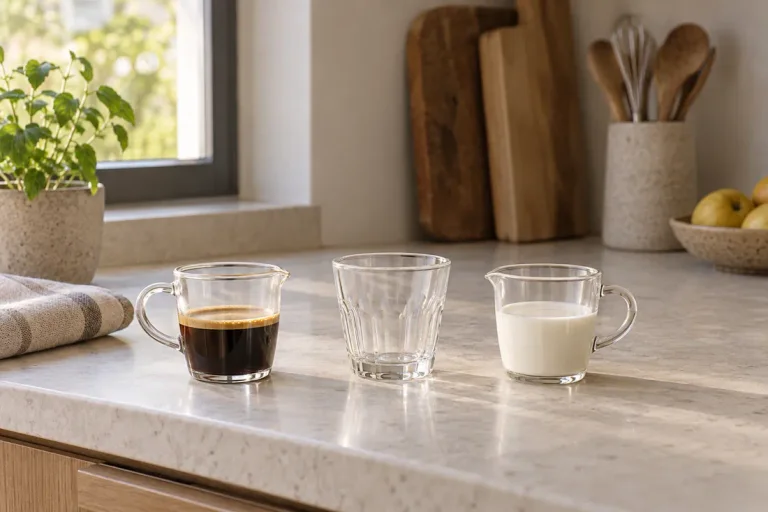
For a straightforward home version, combine 40 mL of espresso with about 40 mL of lightly steamed milk. That gives roughly 80 mL, or 2.7 US fl oz, before allowing for foam. Café recipes vary, so the name alone does not tell you the exact size, shot count or caffeine content.
For a richer espresso drink, our breve coffee guide explains using half-and-half. If you brew a regular pot instead, café au lait pairs brewed coffee with warm milk.
The cortado ratio: start near 1:1
The useful starting idea is equal volumes of prepared espresso and milk. Breville's cortado recipe pairs a double espresso with an equal amount of microfoamed milk, while acknowledging regional and personal differences. Microfoam means small bubbles mixed through the milk, allowing it to pour smoothly.
The 1:1 here is a drink-building ratio. It is different from an espresso brew ratio, which compares dry coffee grounds with the weight of espresso produced. Adding milk does not change how you extracted the shot.
| Prepared espresso | Milk added | Approximate combined volume |
|---|---|---|
| 30 mL | 30 mL | 60 mL / 2 US fl oz |
| 40 mL | 40 mL | 80 mL / 2.7 US fl oz |
| 50 mL | 50 mL | 100 mL / 3.4 US fl oz |
These are serving examples, not instructions to run a shot until it reaches any chosen line. Keep a successful espresso recipe and scale the milk to suit it. If equal parts is too milky for you, reduce the milk a little on your next cup.
Why one café's cortado can look different
La Marzocco's house-menu guide describes regional variations and a small-glass presentation. There is no single glass that makes the drink correct.
The differences can be substantial. Counter Culture's espresso guide lists an example of roughly 2 ounces of espresso with 3 ounces of steamed milk. The current Starbucks US cortado, checked October 13, 2026, uses three Blonde Espresso ristretto shots and steamed whole milk, served in an 8 fl oz short cup. A cup's capacity is not a measurement of the espresso inside it.
When ordering, ask how many shots the café uses and how much milk it adds. “A small espresso drink with roughly equal milk” communicates more than arguing over an ounce boundary. At home, a heat-safe glass or cup around 4 US fl oz gives the 80 mL recipe some headroom.
How to make a cortado at home
Yield: one small cortado, about 80 mL before foam expansion. Preparation: about 5 minutes once your espresso machine is ready. Warm-up time depends on the machine.
- About 40 mL freshly prepared espresso
- About 40 mL lightly steamed milk to add to the drink; start with any larger milk quantity your pitcher or frother requires
Use a small heat-safe serving cup, a suitable milk pitcher and an espresso machine with a steam wand, or a separate milk appliance that can make warm, lightly textured milk.
- Prepare the equipment. Bring the machine to its ready state and warm the serving cup according to its instructions. Have cold milk, a clean pitcher and a thermometer ready.
- Make the espresso. Prepare an approximately 40 mL portion using a recipe suited to your coffee and machine. If you already brew by weight, keep that recipe and use an approximately equal volume of milk.
- Steam the milk lightly. Use the amount needed for your pitcher's working range. Add a little air, then keep the milk moving until smooth and warm. For dairy, around 140–150°F (60–65°C) is a useful starting range; avoid boiling.
- Clean and combine. Turn off the steam before removing the wand. Wipe and purge it as the machine directs, keeping clear of the steam. Swirl the milk and pour about 40 mL into the espresso, stopping before the cup is full.
- Serve promptly. The surface should have a thin layer of fine foam. You do not need a latte-art pattern to finish the drink.
The dairy temperature range follows Breville's guidance for lightly textured milk. It is a preparation target, not a reason to judge temperature by touching hot metal. Use your thermometer and the appliance instructions.
The small milk batch is the tricky part
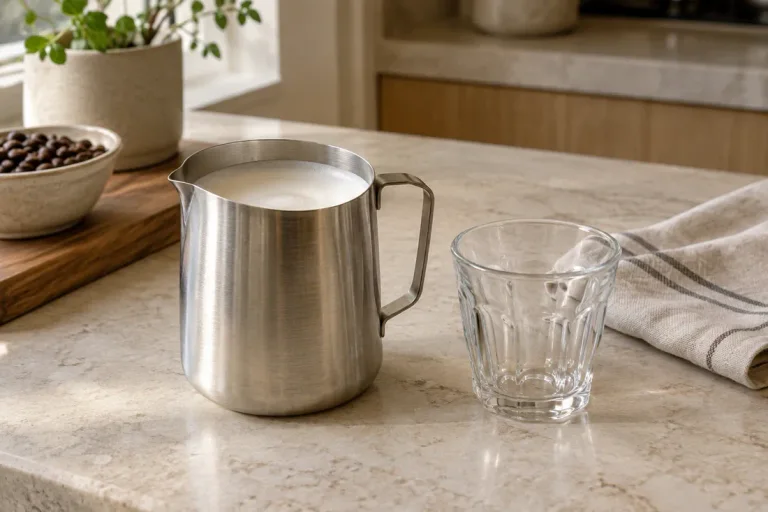
The amount you need to steam may be larger than the amount you need to drink. Forty milliliters can sit too low in a normal pitcher for a wand to create a controlled swirl. Pouring the entire resulting batch into your cortado would change the recipe.
La Marzocco's steaming guide explains that underfilling makes milk harder to control and quick to heat. Choose a small pitcher compatible with your wand, while respecting the equipment's working level. With an automatic frother, its minimum fill still applies.
If the minimum batch is more than you need, make two drinks together when practical, or plan another immediate use for the extra warm milk. Do not keep reheating the same batch. Our cappuccino guide covers wand positioning, aeration and cleanup in more detail.
Watch the texture instead of trying to create as much foam as possible. A little air early in the process, followed by circulation, helps keep the milk flowing. If the result looks like separate hot milk beneath a stiff foam lid, reduce aeration on the next attempt.
Espresso volume, crema and weighing
Espresso's surface foam, crema, makes volume an imperfect way to reproduce a shot. The Specialty Coffee Association describes crema as coffee foam; a visibly taller foam layer does not mean the cup contains proportionally more liquid.
Use the milliliters here to picture the drink. For repeatable espresso, record the dry dose and beverage yield in grams. Stumptown's espresso guide likewise treats grind, dose and extraction time as variables to adjust for the coffee.
Do not silently substitute 40 g for 40 mL and call them identical measurements. If you prefer a weight-based house recipe, record the espresso and added milk by weight, keep that version consistent and judge the result in the cup. The point is a small drink you can reproduce.
Cortado versus flat white, latte and macchiato
| Drink | Milk balance | Choose it when |
|---|---|---|
| Cortado | A small addition, often near equal parts espresso and milk | You want a compact drink with a clear espresso presence |
| Flat white | Usually more milk than a compact cortado, with fine microfoam | You want a longer, smooth milk drink |
| Latte | A larger milk proportion | You want more milk and a longer serving |
| Espresso macchiato | A small mark of milk or foam | You want espresso with a little softening |
| Cappuccino | More emphasis on an aerated foam texture | You enjoy a more noticeable foam layer |
These are useful ordering tendencies; a café's recipe can blur the boundaries. For the wider menu, see our coffee-drinks guide. If a latte sounds closer to what you want, our latte guide covers that balance.
Milk choices and simple adjustments
Whole milk is a reasonable starting choice. If you prefer reduced-fat milk or a plant-based alternative, use it and adjust to its steaming behavior. Follow a plant milk's instructions rather than assuming every oat or almond drink tolerates the same temperature or produces the same texture.
If the drink tastes too milky, check how much you poured before changing the espresso. If the espresso itself tastes harsh or unpleasantly sour, address that recipe first. Extra milk can alter the balance, but it cannot tell you whether your grind or dose was appropriate. Our coffee troubleshooting guide can help isolate the problem.
For a sweeter drink, add sweetener to taste. Syrup is optional; the basic recipe is simply espresso and milk. Keep the first version straightforward so you can tell whether it is the coffee, milk proportion or sweetness you want to change.
Cortado questions
How many espresso shots are in a cortado?
It depends on the café and its espresso recipe. One or two are common recipe descriptions, while Starbucks' US version uses three ristretto shots. Ask about the actual preparation rather than assuming the name fixes the shot count.
Is a cortado stronger than a latte?
With the same espresso dose, a cortado usually tastes more concentrated because it contains less milk. Adding milk does not remove caffeine; a larger latte can contain more caffeine if it uses more espresso. See our caffeine guide for serving-size context.
Does a cortado need ristretto?
No. Ristretto is one possible espresso base, not a requirement for every cortado. Use an espresso recipe you enjoy; our ristretto guide explains that shorter style.
Can I make a cortado with a capsule machine?
Yes. Prepare an espresso-sized coffee and add a similar amount of warm, lightly textured milk. Select an appropriate coffee program rather than a large mug setting, and follow the milk appliance's minimum fill.